
BPM Bits & Business Flows #25: Breaking the Silo Between Spares and Sourcing 🚀
Week 25 concludes Phase 5 by exploring Vertical Asset Integration — how the bpExperts Business Flows framework connects maintenance demand directly to procurement, refurbishment, and inventory strategies, ensuring critical repairs are never delayed by a missing part and giving leaders full visibility into total cost of ownership.
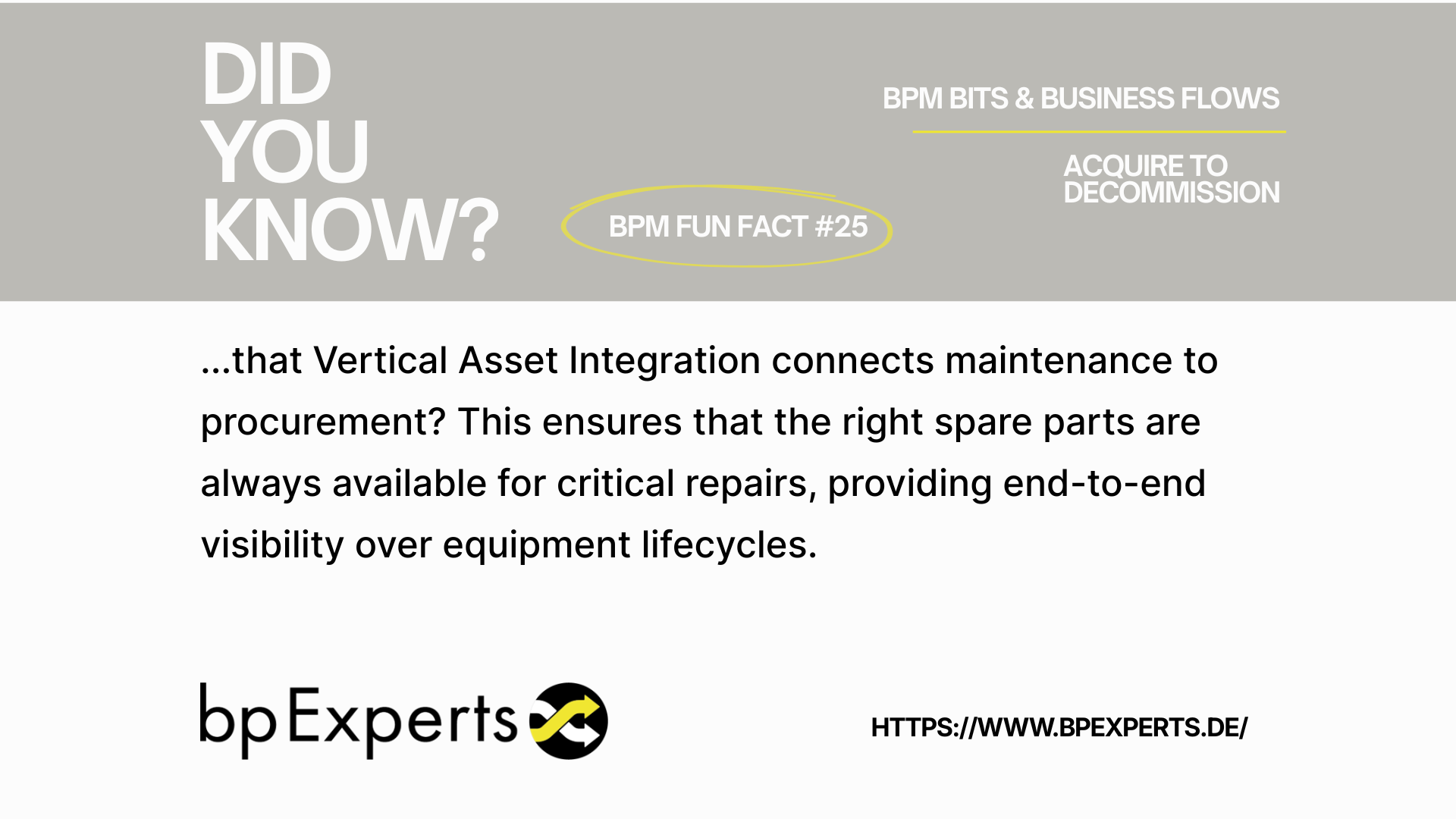
Welcome to Week 25! To conclude our phase on Asset Integrity, we are looking at the critical link between maintaining a plant and sourcing the parts needed to do so.
Fun Fact #25
In the bpExperts Business Flows, we align procurement, refurbishment, and inventory strategies to ensure maintenance teams aren't left waiting for a part.
Did you know?
The most expensive maintenance delays in process manufacturing are rarely caused by technical complexity — they're caused by a missing part that nobody ordered in time. Vertical Asset Integration closes that gap by connecting maintenance demand directly to procurement.
The Expert Deep Dive
Vertical integration transforms maintenance from an isolated task into a coordinated enterprise activity:
Lifecycle Visibility This capability provides end-to-end control over spare parts and equipment, from sourcing to stocking and utilization.
Integrated Demand Planning Maintenance demand is directly linked to procurement processes, ensuring that if a predictive alert triggers a repair, the purchasing department is already in the loop.
Refurbishment Coordination The framework manages internal and external refurbishment of parts, optimizing costs by repairing components rather than always buying new ones.
Why it matters for Process Industry Leaders
Minimized Downtime Critical repairs are never delayed by a missing bolt or sensor.
Total Cost of Ownership (TCO) Leaders can track the full lifecycle cost of an asset, including how much was spent on parts and labor over time.
Inventory Optimization You avoid over-stocking expensive components that are rarely used while ensuring "must-haves" are always on hand.
The Reality Check 💬
How often has a $100 part caused a $100,000 production delay in your plant?
- A) Never — our inventory integration is perfect 🎯
- B) It happens once or twice a year 🗓️
- C) We spend more time waiting for parts than actually fixing things 😴
Let's discuss in the comments! 👇
The bpExperts Take
The silo between maintenance and procurement is one of the oldest and costliest problems in process manufacturing — and yet it persists because the two functions live in different systems, speak different languages, and operate on different timelines.
Closing this gap requires more than a shared spreadsheet or a better ERP module. It requires that maintenance demand, spare parts inventory, supplier lead times, and refurbishment workflows are all modeled as a single, connected process. When that structure exists in Business Flows, a predictive maintenance alert doesn't just trigger a work order — it simultaneously checks inventory levels, initiates a purchase requisition if stock is insufficient, and flags the supplier lead time against the maintenance window. AI agents can then monitor the entire chain in real time, ensuring the part arrives before the repair is needed, not after.
At bpExperts, we eliminate the $100 part that causes the $100,000 delay — by connecting the processes that should never have been separated in the first place.
🚀 Ready to connect your maintenance and procurement processes?
Explore how Business Flows structures your end-to-end asset lifecycle — from health monitoring to integrated sourcing:
👉 Discover Business Flows — bpExperts
Or book a free demo and see how it applies to your plant operations and supply chain.
#BusinessFlows #bpExperts #BPM #AssetMaintenance #SupplyChainIntegration #ProcurementEfficiency #ProcessIndustry #WeeklyBPMBits
Source: ai.bpexperts.de