
The situation
When defining scope and target design for Finance in an S/4HANA transformation, organisations naturally begin with the obvious questions: Which Finance processes do we run today? How should they be executed tomorrow? What are the system requirements?
These are valid questions, but they are not enough.
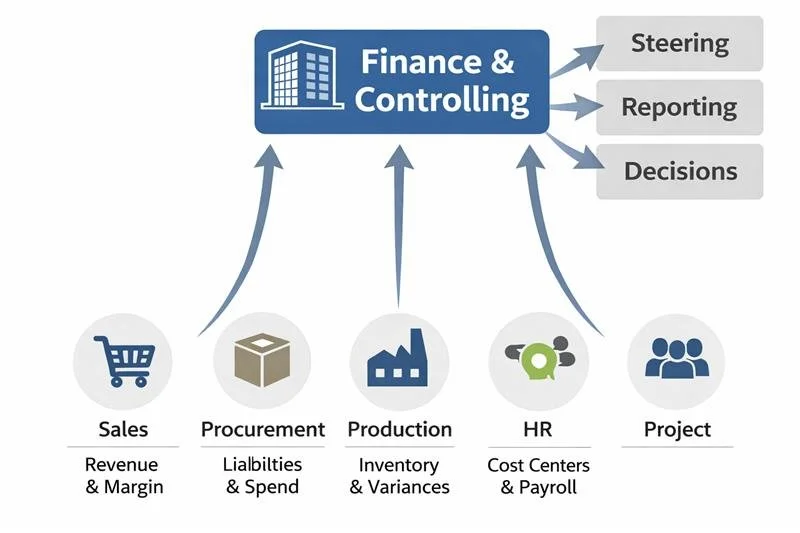
Experience shows that Finance scoping and design efforts often remain too narrowly focused on the Finance function itself. This regularly results in gaps during blueprinting, delays during testing, and unpleasant surprises after go-live. The reason is simple: Finance & Controlling do not operate in isolation. They are the point where business activity becomes measurable, reportable and steerable.
Therefore, defining the right Finance scope requires a broader perspective.
What must be considered
A robust Finance design for S/4HANA should be built on three connected dimensions.
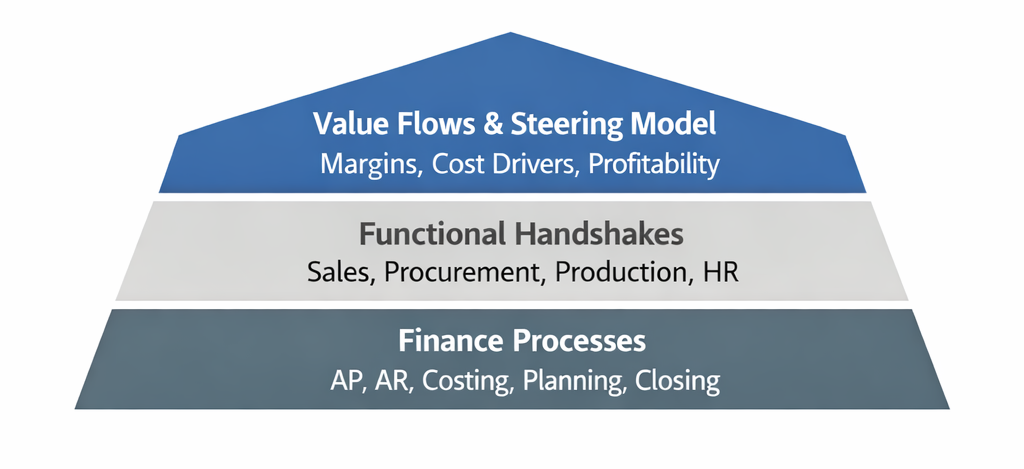
1. Processes executed within Finance & Controlling
Naturally, the first dimension is the set of processes directly owned or executed by FI/CO.
Example areas include:
Accounts Payable
Accounts Receivable
Asset Accounting
Closing and Consolidation
Cost Centre Accounting
Product Costing
Profitability Analysis
Planning and Internal Allocations
Processes in these areas define core responsibilities, roles, controls and reporting requirements. They remain the backbone of Finance transformation.
However, they only represent part of the picture.
2. Interfaces and handshakes with other domains
Finance outcomes depend heavily on how other business functions operate.
Sales influences revenue recognition, receivables, margins and profitability reporting. Procurement drives supplier liabilities, purchasing spend and material valuation. Production impacts inventory, work in progress, variances and product cost. HR influences payroll postings and cost allocations.
If these handshakes are not clearly designed, Finance issues often surface too late.
Typical examples include:
unclear ownership of master data
incomplete posting triggers
inconsistent approval workflows
missing reconciliation points
reporting mismatches between functions
For this reason, Finance scoping must always be cross-functional.
3. Value flows and the future steering model
Most important of all is understanding value flows.
Value flows describe how operational events from across the enterprise translate into financial postings, management reporting and controlling insight. They bridge the world of execution and the world of steering.
Examples include:
goods issue becoming cost of goods sold and customer invoice becoming revenue
goods receipt becoming inventory and supplier liability
production confirmation becoming activity allocation and variance capture
service delivery confirmation becoming margin and profitability reporting
When value flows are not clearly defined, organisations may still run processes, but they struggle to steer the business effectively.
This is why Finance design should not start with transactions alone. It should also ask:
Which margins must management understand?
Which cost drivers matter most?
How should profitability be analysed?
Which dimensions must planning and actuals align on?
Which decisions should reports enable?
The answers shape the future steering model and therefore the required Finance design.
The right approach
Successful S/4HANA Finance transformations pin down scope and design by combining all three perspectives:
Finance processes – what Finance & Controlling executes
Functional handshakes – how Finance integrates with the business
Value flows – how operations become insight and steering capability
Only when these three dimensions are aligned can Finance move beyond bookkeeping and become the management cockpit of the enterprise.
In summary
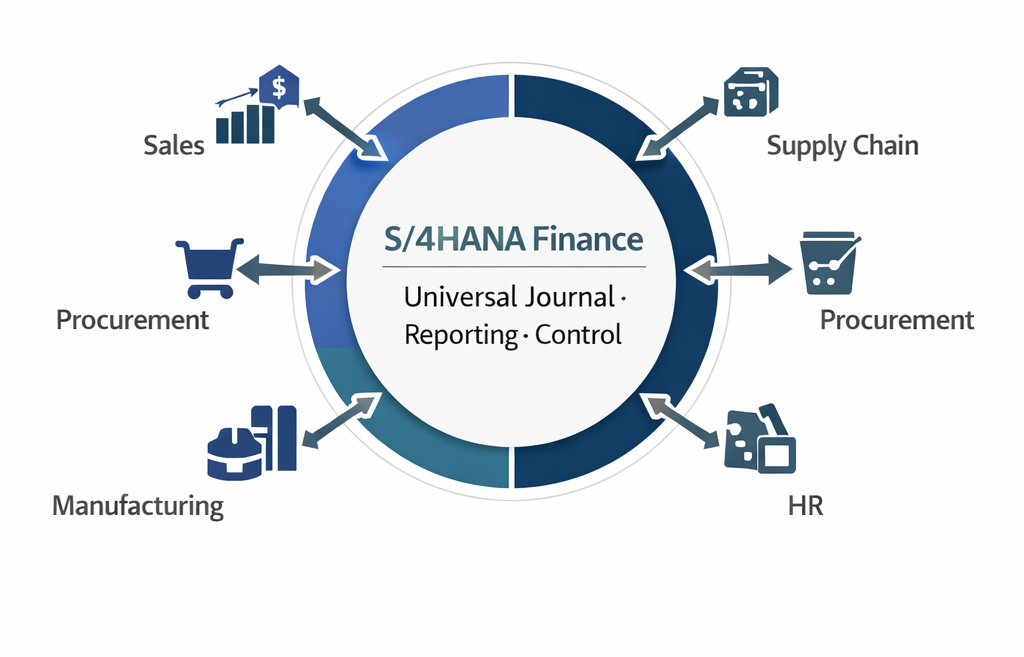
Finance scoping in S/4HANA projects is not an isolated FI/CO exercise. It is a business design exercise with Finance at the centre.
Those who focus only on transactions may implement a system. Those who understand processes, interfaces and value flows enable successful transformation and build a solution for steering the future business.
We at bpExperts have developed Business Flows, a reference process repository that combines structured end-to-end process architecture with clear mappings to value flows, helping organisations define scope and target design with greater precision in S/4HANA transformations.
If you would like guidance on how to apply this approach and successfully implement it in your own S/4HANA project, feel free to reach out to us.