
How Organisations Can Embed AI Into Real Transformation
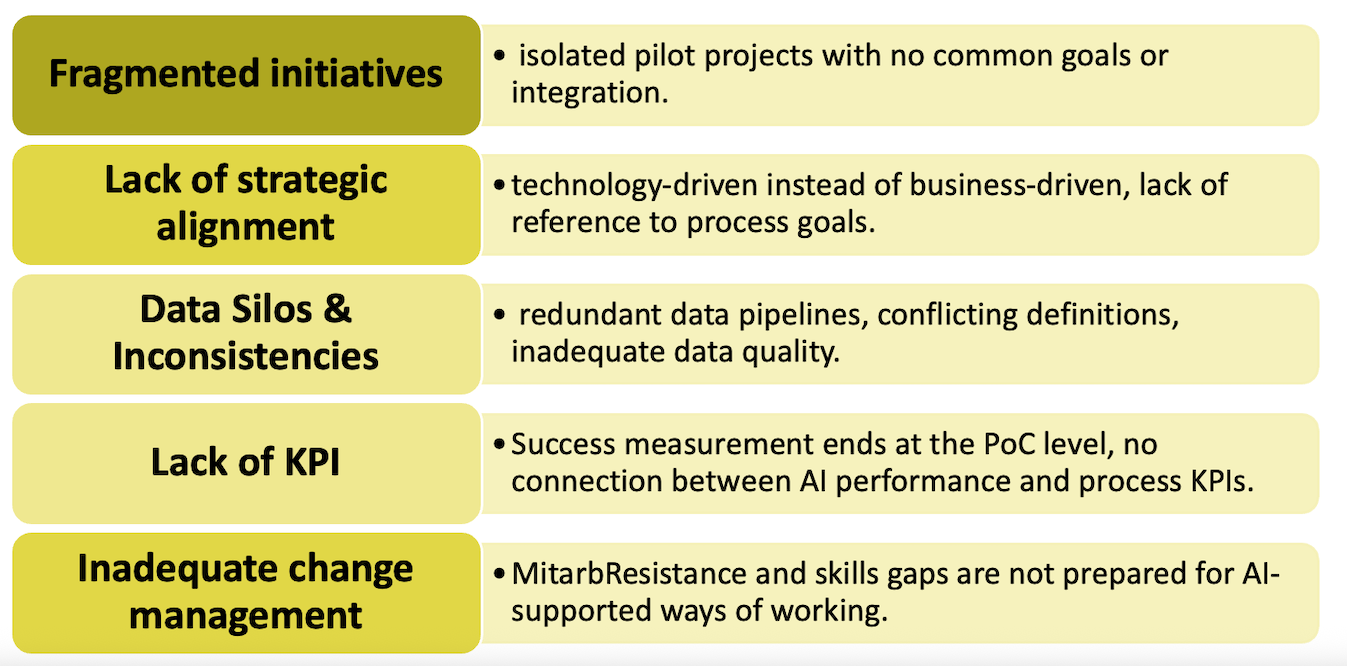
Artificial Intelligence is rapidly becoming the headline topic in every boardroom. Yet, many AI initiatives stall before they deliver measurable value. The root cause is surprisingly simple: organisations treat AI as a project, instead of seeing it as an integral part of their process landscape.
In my keynote during KI-Week, I explored why successful AI adoption requires a process-centric mindset, how companies can structure their initiatives, and what it takes to scale AI sustainably across an organisation. The following article summarises these core ideas.
The long Road Through BPM - And What It Means for AI
Anyone who has worked long enough in Business Process Management knows: it’s a battle. Not war — but definitely a continuous fight for clarity, structure, and alignment across teams.
Since my first deep dive into BPM back in 2005 at IDS Scheer, and later when joining bpExperts in 2012, one insight has stayed constant:
Process management isn’t a toolbox. It’s a way of thinking.
And AI needs exactly this way of thinking to succeed.
AI initiatives launched “because the technology is there” usually fail. AI initiatives launched because a business process needs improvement have a real chance of delivering value.
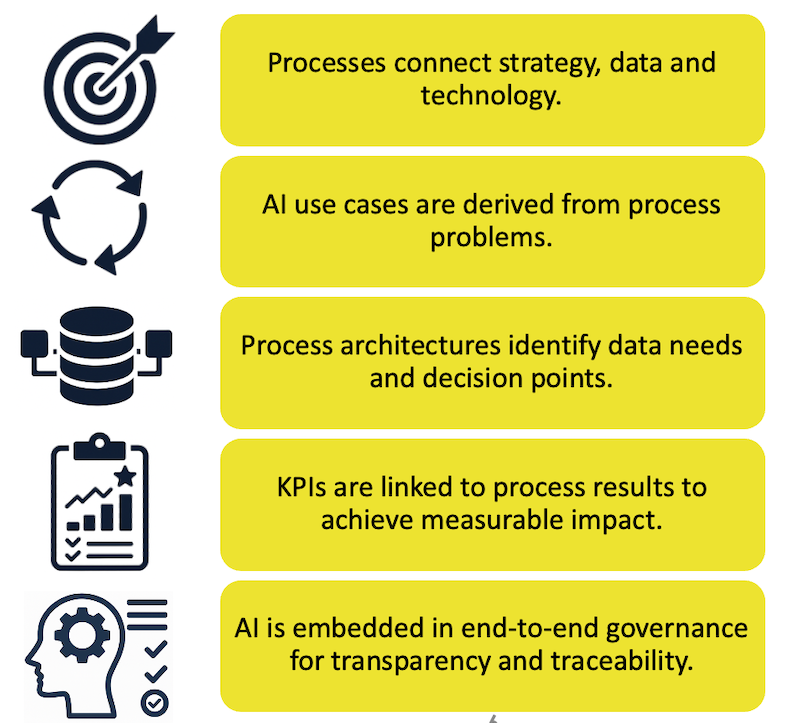
Reasons for Process Centric AI
Why AI Must Be Embedded in Your Process Architecture
Too often, organisations start AI activities in isolation — a chatbot here, a document classifier there, an automation experiment somewhere else. The result is a collection of disconnected pilots with no strategic or operational anchor.
A process-centric approach changes that.
1. Strategy and operations stay connected
Processes operationalise strategy.
Embedding AI into processes ensures your AI efforts support strategic goals instead of creating technical “side projects”.
2. Clear roles and responsibilities
A process model clarifies:
Which roles interact with AI
Who owns the data
Where decisions are made
How compliance and governance are ensured
Without this clarity, AI becomes a black box nobody feels accountable for.
3. Understanding where AI actually adds value
AI makes sense where:
Tasks are repetitive but variable
Unstructured data must be analysed
Complex decisions require support
Manual handovers generate delays or errors
Documents need comparison, validation, extraction
But many pain points can be solved more easily:
with basic digitalisation,
with standard ERP functionality,
or by adjusting process logic.
A structured process assessment very quickly separates true AI use cases from tasks that only look like AI problems.
AI Use Cases Need a Clear Evaluation Framework
To avoid hype-driven decision-making, organisations should assess every use case along a consistent canvas:
✔ Data readiness
Do we have the required input (structured, unstructured, labelled, historical)?
✔ Process impact
Which steps, handovers, and decisions are affected?
✔ Financial expectations
Is there a measurable business case — cost savings, throughput, quality, risk reduction?
✔ Strategic relevance
Does the use case contribute to strategic goals or capability building?
✔ Change & Adoption
Which roles must learn new work patterns?
What training, enablement, and organisational adjustment is needed?
Addressing these questions first, avoids “cool experiments” and instead builds a portfolio of well-positioned, value-oriented, outcome-driven AI cases.
Before Starting: Assess Your AI Maturity
Every AI initiative should begin with a quick maturity check across five success factors:
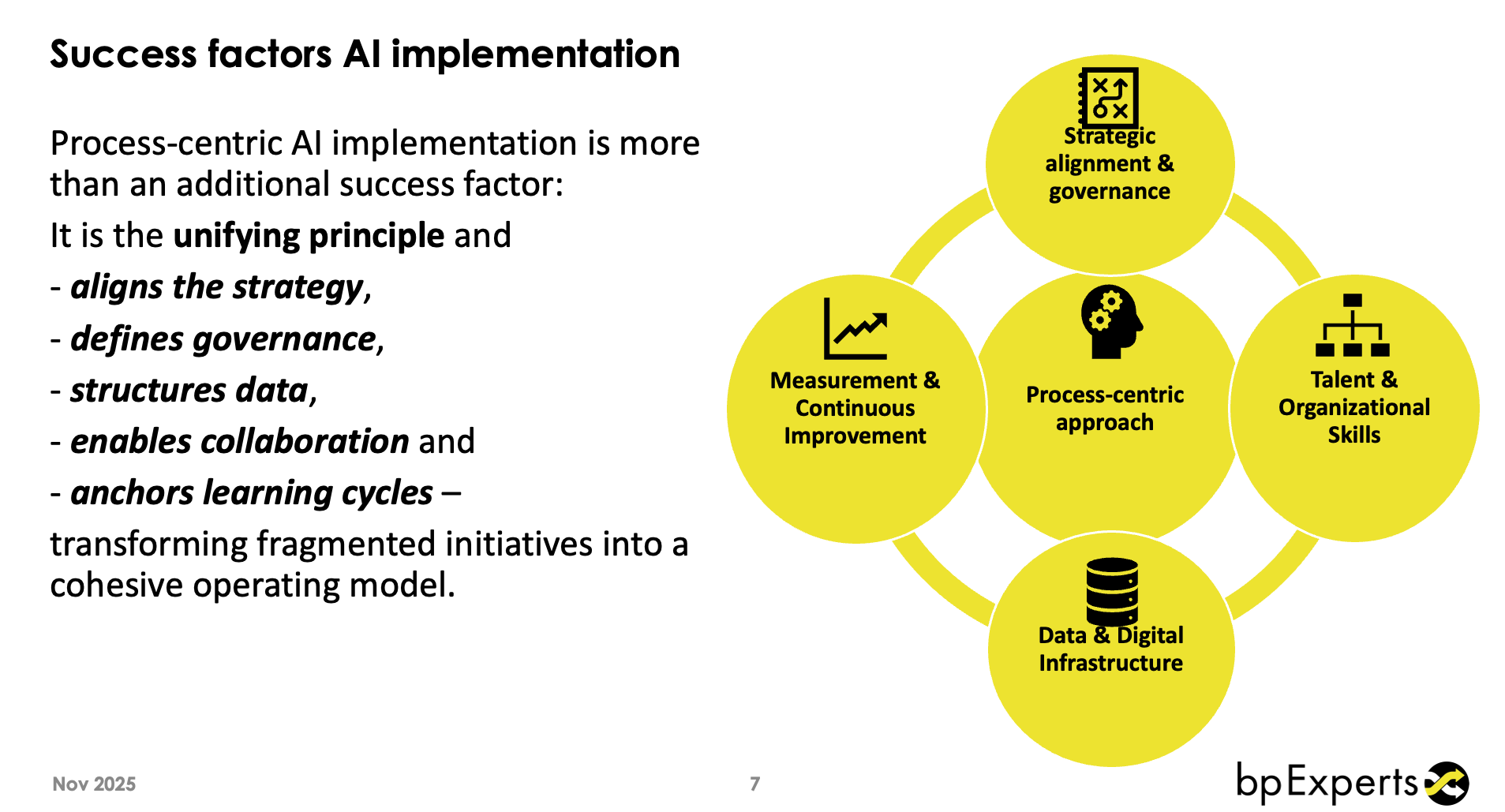
Process governance
Data governance
Roles & responsibilities
Technology readiness
Change & adoption capability
This determines whether the organisation is ready to scale AI beyond isolated pilots — or whether foundational work must come first.
The Role of New (and Evolving) Responsibilities
AI changes the organisational landscape.
Companies must answer questions such as:
Do we still need classical key users?
Should process owners evolve into “AI champions”?
Do we introduce dedicated AI governance roles?
How does compliance adapt to AI-driven decisions and data flows?
Existing governance models shouldn’t be replaced — but challenged and expanded to include AI-specific responsibilities.
From Chaos to Structure in Three Months
In many client projects, we see dozens of parallel, uncoordinated AI activities — each started with good intent but without integration.
With a structured process- and governance-driven approach, organisations can:
consolidate their AI activities,
establish a unified roadmap,
clarify data and process responsibilities,
and align all ongoing projects to a common direction.
This can be achieved in as little as three months, depending on stakeholder engagement. What follows — scaling pilots into daily operations across multiple sites and departments — naturally takes longer, but the foundation is laid.
A Practical Example: Should You Give the “Actual Process” to an AI for Improvement?
One question from the KI-Week audience was:
“If I document my current process and feed it into an AI, can the AI generate improvement suggestions?”
The answer: Yes — but start one step earlier.
If no consistent process documentation exists, begin with:
the key questions process managers must answer,
the roles involved,
the decision points,
the data that flows through the process.
Without this context, AI suggestions remain shallow. With the right context, AI can highlight improvement potential across decision logic, handovers, data usage, and automation opportunities.
Conclusion: AI Needs Process Thinking
If we summarise everything into three messages, it’s this:
1. AI requires a process mindset, not a project mindset
Technology alone doesn’t solve problems.
Embedded in processes, AI becomes a strategic accelerator.
2. Your process models are the compass for AI transformation
They provide orientation, responsibility, data structures, and governance.
3. Every use case must be evaluated in the context of the whole organisation
Only then can AI scale sustainably instead of becoming a collection of isolated experiments.
Organisations that embrace this process-centric AI approach will not just implement technology — they will build lasting capabilities for transformation.