
At bpExperts, we often see organizations successfully connecting SAP Signavio with SAP Cloud ALM — but still struggling to turn that connection into real insight. The typical setup works, yet remains fundamentally limited.
Process models are synchronized, fit-gap analyses are carried out externally, and meaningful insights are created manually. In essence, the integration acts as a pipeline for data — not as a system for understanding.
This raises a simple but important question:
What if your process architecture could do more than just store information? What if it could reason?
From Integration to Intelligence
To move beyond this limitation, we built an AI-native Business Framework Knowledge Graph. Instead of exporting process data into static structures, the entire architecture is represented as a connected system within a Neo4j graph.
Processes, capabilities, SAP scope items, and even AI use cases are no longer isolated elements. They become part of a living structure where relationships are explicit and can be explored dynamically.
At the same time, SAP Cloud ALM is connected directly, providing access to live project data, scopes, and BPMN models. This creates a continuous link between architecture and execution.
With AI embedded into this setup, the system can not only retrieve information but also analyze relationships, identify inconsistencies, and generate insights across the full architecture.
The difference between a traditional integration and an AI-native architecture becomes clear when visualized:
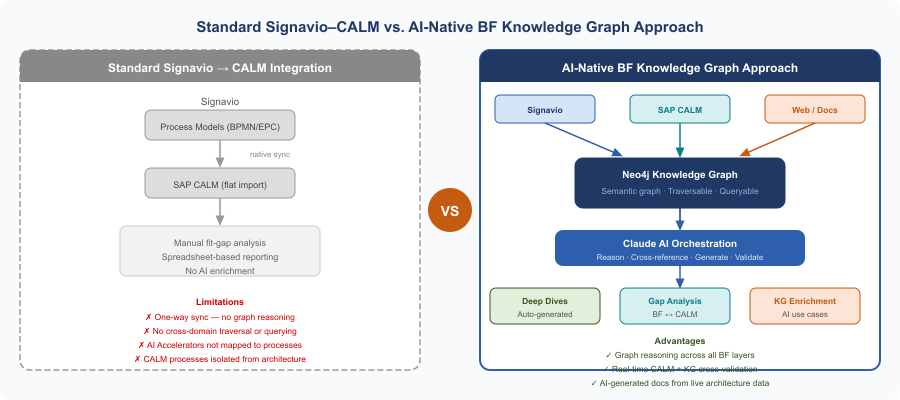
Instead of a linear flow of data, the architecture becomes a connected system where relationships can be explored and analyzed in real time.
What Changes in Practice
The impact of this approach becomes clear very quickly. Instead of working with static exports and disconnected analyses, teams can interact with a live, queryable architecture.
Questions that previously required manual effort across multiple tools can now be answered in real time. Gaps between intended architecture and actual implementation become visible immediately. Process models can be interpreted in context, not just viewed in isolation.
In practice, this setup creates a tightly integrated environment across process architecture, implementation, and AI-driven analysis:
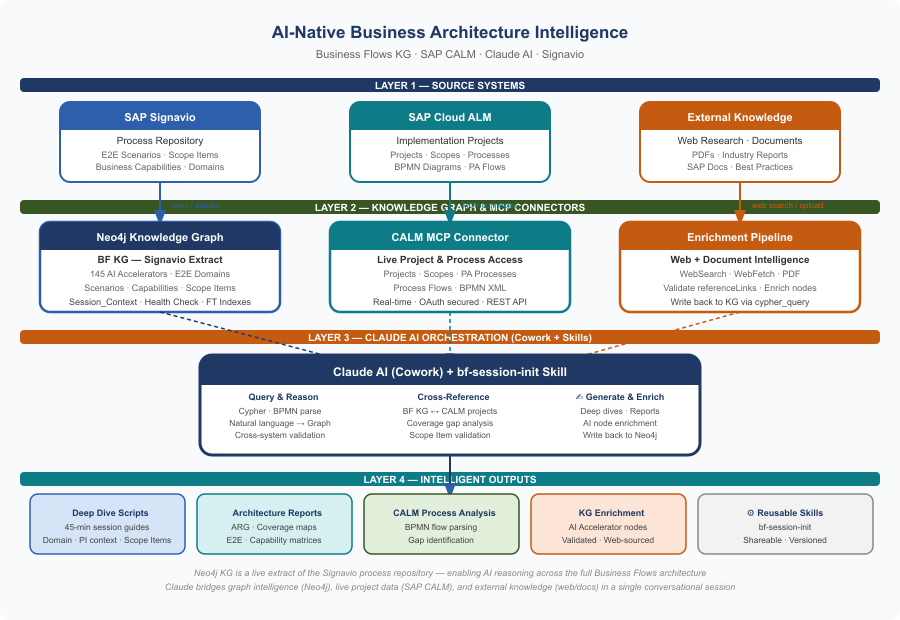
This allows teams to move from static documentation to dynamic interaction with their process landscape. Even complex deliverables such as deep-dive analyses or architecture documentation can be generated directly from the underlying data, ensuring consistency and significantly reducing effort.
A Shift in Perspective
The key difference is not technical, but conceptual.
A traditional Signavio–CALM integration acts as a pipe. Data moves from one system to another, but understanding remains external.
A knowledge graph-based approach acts as a brain. The architecture becomes something that can be explored, questioned, and reasoned over.
As a result, the nature of the questions changes. Instead of asking what is in scope, organizations can start asking what is missing, where overlaps exist, and where the greatest value can be created.
Looking Ahead
This approach is only the starting point. The next steps focus on strengthening the connection between architecture and execution, enabling bi-directional synchronization, enriching the graph with additional data sources, and generating insights directly from live project activity.
Final Thought
This is what AI-native BPM looks like in practice. Not an additional layer on top of existing tools, but intelligence embedded directly into the architecture itself.