
The Brain Gets Smarter: How Multi-Agent AI Turns a Process Repository into a Living Intelligence System

The Brain Gets Smarter: How Multi-Agent AI Turns a Process Repository into a Living Intelligence System

A follow-up to: "Your Signavio–CALM Integration Is a Pipe. We Built a Brain."
In our previous article, we showed how connecting SAP Signavio and SAP Cloud ALM through a knowledge graph transforms a data pipeline into something that can reason. The brain existed. It could answer questions about what was in scope, where gaps were, and how processes connected to SAP scope items.

The question we kept getting was: what does the brain actually think — and how does it get smarter over time?

This article is the answer.

The problem with a brain that only knows process structure

A knowledge graph of processes, E2E domains, SAP scope items, and capabilities is a powerful foundation. But it answers only one type of question: what is. What processes do we have. What scope items are in scope. What scenarios the reference model defines.

The questions that actually drive value in BPM engagements are different. They are questions like:

  • Which AI use cases are validated for our Order-to-Cash scenarios, and what economic value do they represent?

  • If we automate invoice matching with an autonomous AI agent, which compliance obligations apply — and what controls must be built into the process design before we even talk about go-live?

  • Should we use SAP standard or a best-of-breed solution for financial planning, and where does that decision change if we need sophisticated scenario modelling?

These questions require not just process knowledge, but three additional dimensions: innovation context (what AI use cases exist and what they deliver), compliance knowledge (what regulatory obligations apply to which processes and AI systems), and balanced evaluation (how competing solution options score against each other).

And they require these dimensions to be in genuine tension with each other — argued, scored, and resolved — not averaged away into a diplomatically acceptable middle ground.
Adding the three dimensions to the brain

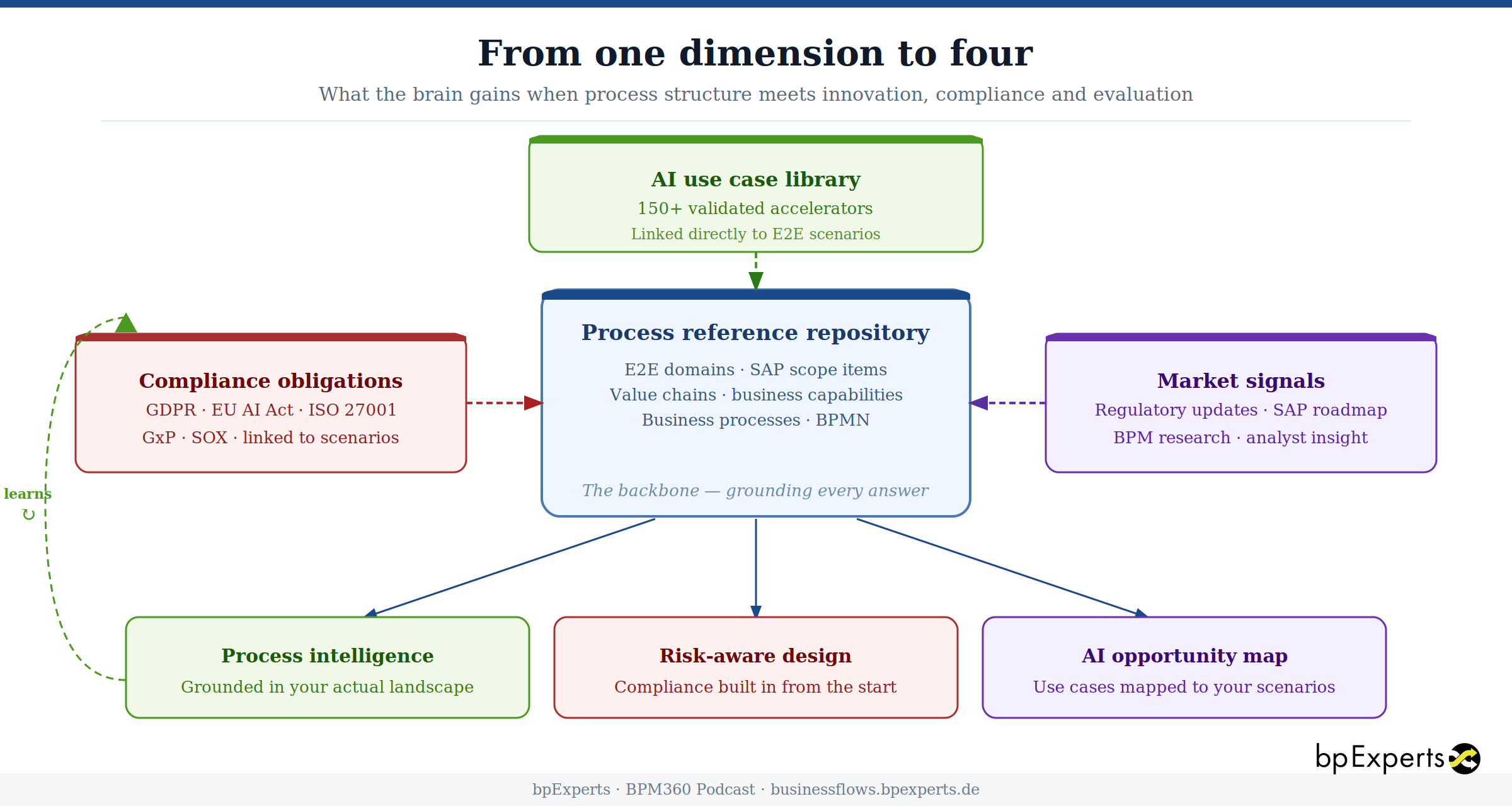
The process reference repository remains the backbone. It is what grounds every answer in the structure of your actual process landscape, not in generic best practice.

But now three knowledge streams flow into it continuously.

AI use cases are mapped directly to E2E scenarios. When a process analyst surfaces a specific scenario — say, vendor invoice clearing in the A2R domain — the system already knows which AI accelerators have been validated for that scenario, what their descriptions are, and what transformation they enable. This is not a generic list of AI possibilities. It is a specific, curated set of use cases anchored to your process structure.

Compliance obligations are structured as knowledge nodes, linked to the scenarios they constrain. GDPR Article 22 (automated decision-making) is linked to every scenario where an AI system could make decisions affecting individuals without human review. SOX segregation of duties obligations are linked to every A2R, O2C, and Pl2P financial flow. GxP validation requirements are linked to quality management scenarios. When a scenario is surfaced in a debate, the compliance obligations that apply to it are loaded automatically — not looked up manually, not forgotten.

Market signals — regulatory updates, BPM research, SAP roadmap developments — flow in as additional context that the agents can draw on when the question requires current awareness rather than only structured reference data.

What makes this different from simply having three separate databases is the graph structure. The relationships are explicit. An AI use case is not just "relevant to financial planning" — it is specifically linked via a typed relationship to the E2E scenario it accelerates. A compliance obligation is not just "applicable to AI" — it is linked to the specific AI accelerators it flags, with the penalty range and mandatory controls stored on the obligation node itself. When agents query the graph, they are not doing keyword search. They are traversing a connected structure that encodes what belongs together and why.
Why multiple agents — and why they debate

The conventional approach to AI-assisted BPM advisory is a single conversation: ask a question, get a response. The response is usually balanced, reasonable, and completely uncommitted. It acknowledges that AI offers opportunities but also has risks. It notes that SAP standard and best-of-breed both have merits. It concludes with a recommendation to assess the specific context.

This is not useful to a practitioner trying to make a real decision.

What a good BPM recommendation actually requires is for competing perspectives to be articulated clearly, placed in genuine tension with each other, and resolved through a structured process — not smoothed away by a single model optimising for diplomatic acceptability.

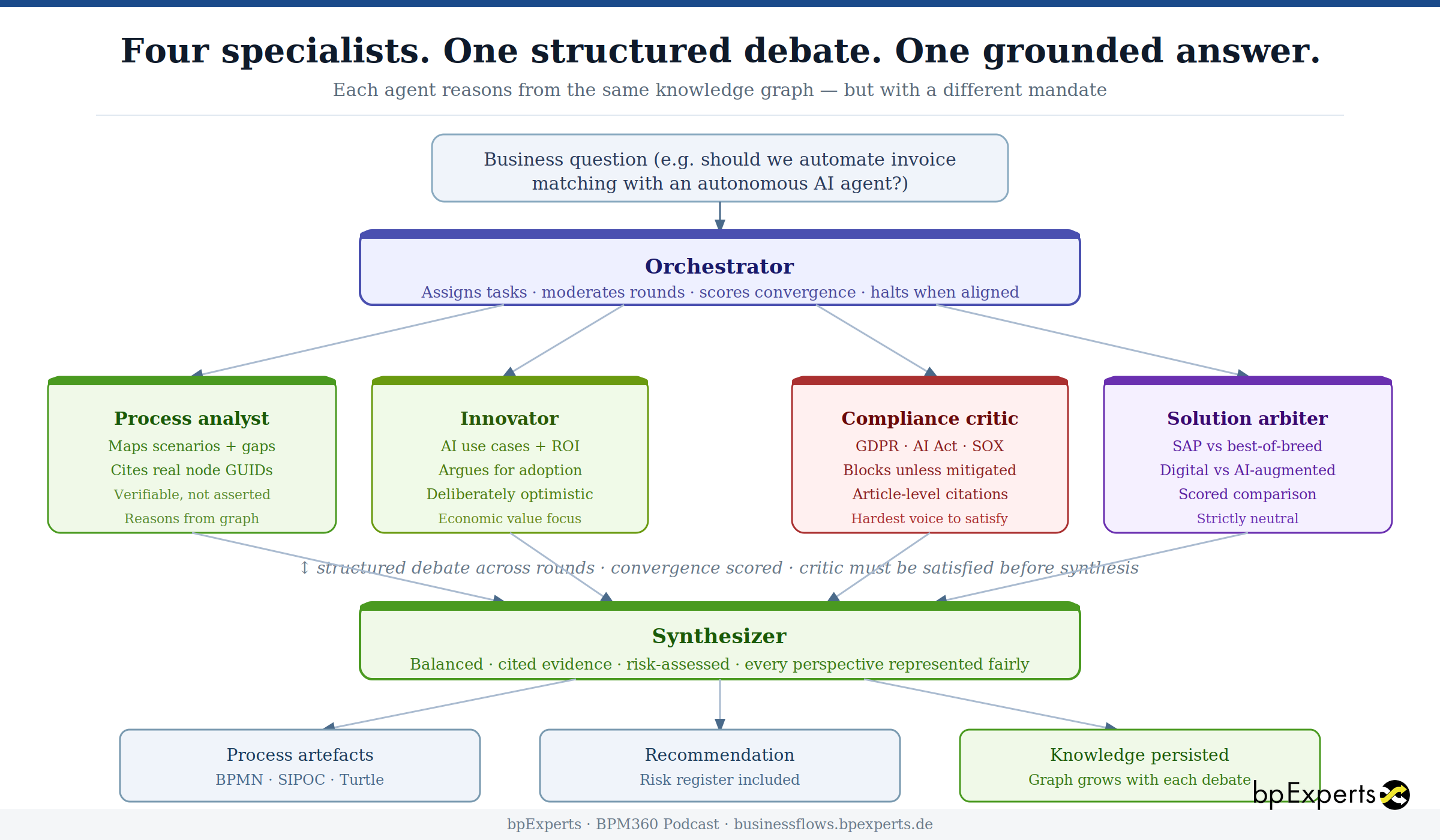
The multi-agent approach makes each perspective a specialist:

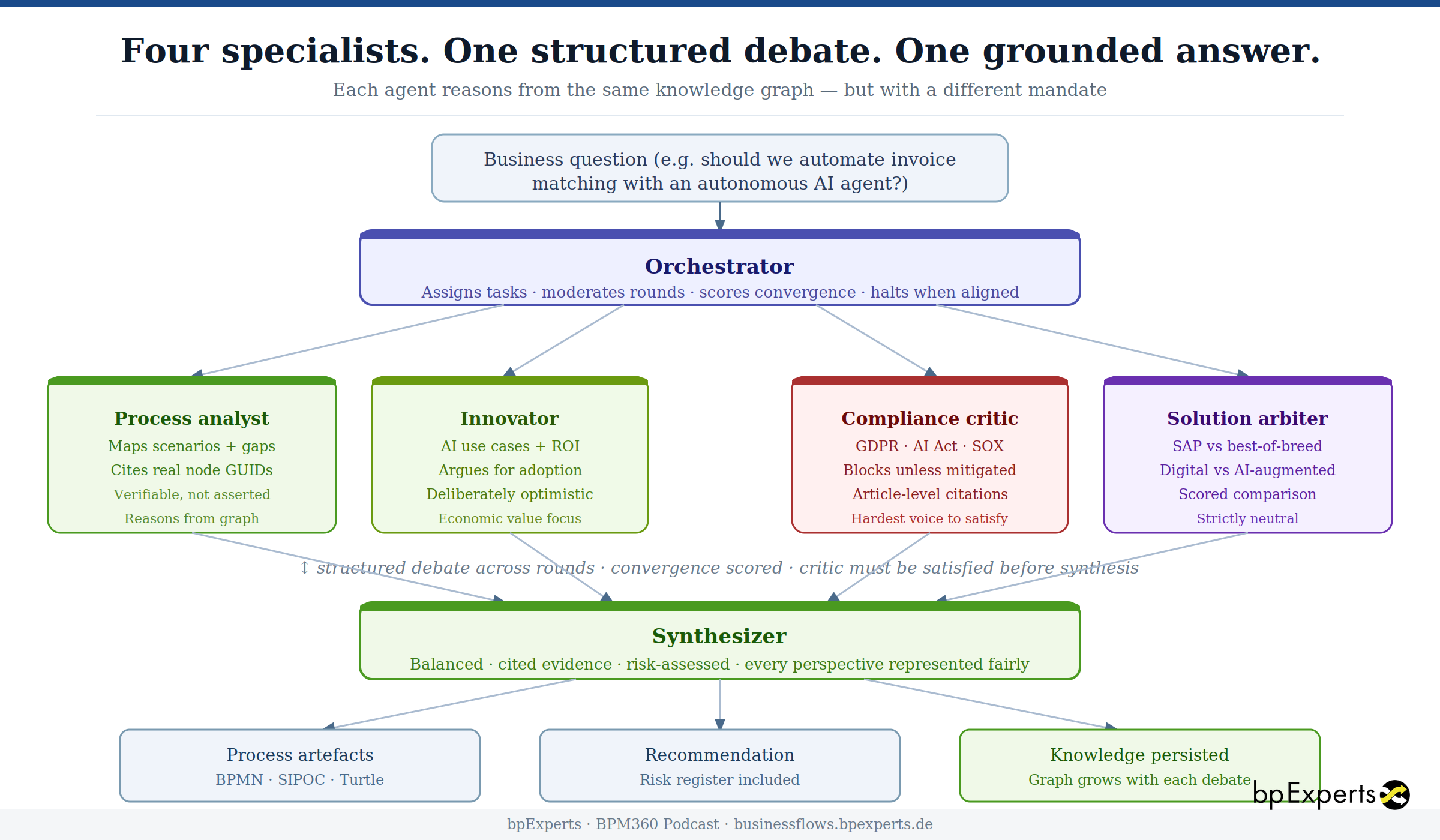
A process analyst maps the question against the reference repository. Which E2E scenarios are implicated? Where are the gaps between current-state coverage and the reference model? What scope items should be in scope but aren't? This agent reasons from graph evidence and cites node IDs — its findings are verifiable, not asserted.

An innovator evaluates the economic opportunity. Which AI accelerators are mapped to the implicated scenarios? What is the case for digitalization and AI-augmentation? This agent argues for adoption when the evidence supports it — it is deliberately optimistic, not artificially neutral.

A compliance critic stress-tests every proposal against the applicable regulatory frameworks — GDPR, EU AI Act, ISO 27001, GxP, SOX. It enters the debate knowing which obligations are linked to the scenarios under discussion, and it argues against adoption unless those obligations can be met. It is the hardest voice to satisfy. That is its value. When the critic flags that an autonomous invoice reconciliation agent triggers GDPR Article 22, SOX segregation of duties, and EU AI Act Article 14 (human oversight requirements), it does so with specific article citations, penalty ranges, and mandatory controls — not with a generic "please consider data protection".

A solution arbiter evaluates the solution options on a scored matrix. SAP standard versus best-of-breed. Digital process automation versus AI-augmented solutions. It scores each on functional fit, implementation effort, TCO, vendor lock-in, and time-to-value — without favouring either axis.

An orchestrator runs the debate. It assigns questions to agents, collects positions, scores convergence, and decides when the positions have sufficiently aligned to produce a synthesis. If the critic has unresolved CRITICAL risks, the debate continues. If all four agents have reached compatible positions, the orchestrator halts and hands the transcript to the synthesizer.

The synthesizer produces a final output that represents every perspective fairly — including unresolved risks, which are flagged prominently rather than buried in a risk register no one reads.

The process designer then converts the agreed synthesis into formal process artefacts: BPMN process structures, SIPOC tables, and Turtle diagrams that already encode the compliance controls that the debate established are mandatory. The human-in-the-loop checkpoint that GDPR Article 22 requires is not added later as an afterthought — it is modelled in the BPMN from the start because the critic made it a precondition of convergence.
What continuous learning actually means

A system that answers a question once and then forgets everything is not meaningfully intelligent. The brain needs to accumulate.

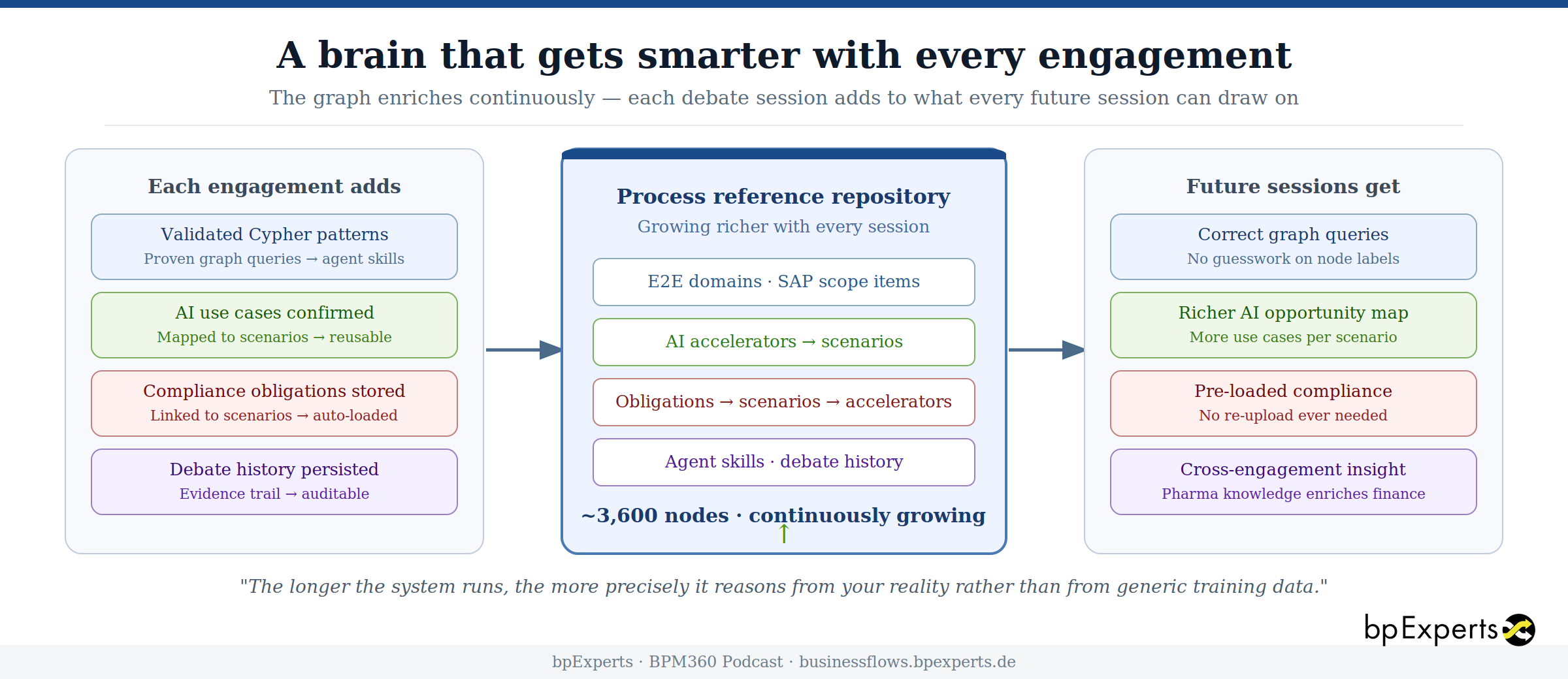
Every debate session writes back to the graph. The positions each agent took, the evidence nodes they cited, the risks the critic raised — all become part of an auditable history that can be queried, analysed, and learned from.

More importantly, the knowledge the system acquires in one engagement becomes available in the next. A compliance document uploaded for a pharmaceutical client — a GxP SOP, an ISO 27001 policy, a GDPR transfer impact assessment — is stored as a structured knowledge node, linked to the scenarios it constrains, and automatically loaded by the compliance critic in every future debate where those scenarios appear. The document does not need to be re-uploaded. The obligation does not need to be re-explained.

Cypher query patterns that prove reliable in one engagement become encoded as agent skills — loaded into the relevant agent's context at the start of subsequent debates so that it immediately knows the right way to traverse the graph for that type of question.

The reference model itself grows richer with every project. AI use cases validated in one client engagement are linked to scenarios and available for the next. Compliance obligations structured for one industry are automatically scoped to others where the same frameworks apply.

This is not model retraining. The underlying LLM does not change. What changes is the graph — progressively more scenarios mapped, more AI use cases validated, more compliance obligations structured, more proven reasoning patterns encoded. Each engagement benefits from every previous one. The longer the system runs, the more precisely it can ground its answers in the specific structure of your process landscape rather than in generic knowledge from training data.

The shift this creates in practice

For practitioners, the change in conversation is significant.

The starting point shifts from "based on our experience, we recommend..." to "based on your process structure — mapped against the reference model, with the following AI opportunities identified in the graph and the following compliance obligations confirmed — our recommendation is..."

The recommendation may be the same quality of judgement. The foundation is demonstrably different. The process analyst cited twelve node GUIDs. The compliance critic cited specific articles with specific penalty ranges. The solution arbiter produced a scored matrix. Every claim is traceable.

For organisations evaluating AI-assisted BPM advisory, the question to ask is not "how intelligent is the AI?" but "what does it reason from?" A system reasoning from a structured, compliance-linked, AI-enriched process repository is a fundamentally different proposition from a system reasoning from training weights alone — regardless of model size.

The reference repository is the IP. The agents are the reasoning engine. Together they produce something neither can produce alone: BPM intelligence that is grounded in your reality, balanced across competing perspectives, compliant by design, and continuously improving.

The pipe became a brain. Now the brain is learning to think for itself.

At bpExperts we are building and validating this approach in live client engagements. The architecture described here is the result of sustained development — connecting SAP scope items, AI use cases, and regulatory obligations into a knowledge graph that specialist agents reason from in real time. We are happy to explore what this looks like for your organisation.

Follow the BPM360 Podcast for the intersection of process management, AI, and organisational transformation.

Business Flows 2.0 Release Overview: From Generic Foundations to Industry-Specific Execution

bpExperts is proud to announce the latest Business Flows 2.0 (BF 2.0) release—a structured, SAP-aligned repository of business processes designed to support real-world SAP transformation initiatives.

This release delivers value in two distinct ways. It enhances the Generic Industry version with improved structures and updated content, and it introduces a new Process Industry repository tailored specifically to the operational realities of process-driven organizations.

With Business Flows 2.0, organizations gain greater transparency across their process landscape, faster and more reliable process scoping, and actionable insights that accelerate SAP-driven transformations from the earliest phases. The BF 2.0 release is guided by a consistent set of principles applied across both the Generic and Process Industry content, ensuring that improvements are not isolated changes but part of a coherent overall design.

What Makes This Release Special

A defining element of this release is the enhanced Business Flows metamodel, which introduces industry-specific transformational drivers and business capabilities that are explicitly modeled and visible:

  • Carefully selected, industry-relevant end-to-end scenarios were defined for the Process Industry, focusing on real operational business cases rather than generic functional flows.

  • Industry-specific transformational drivers and business capabilities are explicitly represented, making the link between strategic objectives, processes, and execution transparent and actionable.

  • For the first time, SAP scope items, business capabilities, and SAP solutions are officially introduced and implemented together, ensuring that process content is directly aligned with what SAP solutions support in practice.

👉 Request a demo session to explore Business Flows 2.0 and see how industry-specific process content can accelerate your SAP transformation.

Process Industry Development Approach

As part of the BF 2.0 release, a dedicated Process Industry (PI) version has been introduced. It complements the Generic Business Flows by providing tailored structure and content for process-driven organizations and serves as a blueprint for future industry-specific releases.

SAP-Aligned Domain Coverage

The Process Industry repository spans eight SAP-aligned end-to-end domains:

  • Idea to Market

  • Plan to Fulfill

  • Lead to Cash

  • Source to Pay

  • Finance

  • Acquire to Decommission

  • Governance

  • Recruit to Retire

Objectives of the Process Industry Release

The objective of this release is to enable effective scoping, design, and implementation of SAP-aligned business flows by:

  • Establishing a comprehensive, industry-specific process repository

  • Deploying the content on SAP Signavio for immediate use in modeling and analysis

  • Supporting efficient mapping of real business cases to SAP solution capabilities

  • Highlighting process-industry-specific transformational drivers and business capabilities to support targeted business outcomes

Development Methodology

The Process Industry content was developed using a structured and reusable approach:

  • The Generic Business Flows served as a baseline to ensure architectural consistency

  • Industry-specific business cases (such as Sell-from-Stock, Third-Party Procurement, and Manufacturing Site operations) defined the primary scope

  • Industry-centric scoping focused on operational realities rather than functional decomposition

  • Validation against SAP solution capabilities ensured feasibility and alignment

  • Dedicated libraries of transformational drivers and business capabilities support measurable value realization

Repository Structure and Benefits

The Process Industry repository provides multiple perspectives to support navigation and analysis:

  • Industry View for selecting relevant content

  • Domain View aligned to SAP end-to-end domains

  • Industry-specific E2E scenarios and transformational drivers

  • Detailed E2E flows linked to business capabilities and SAP scope items

This enables organizations to:

  • Accelerate process scoping and design using predefined industry standards

  • Align business processes directly with SAP solution capabilities

  • Identify key transformational drivers and required business capabilities

  • Maintain a consistent, structured, and reusable process repository

Generic Industry Highlights

The Generic Industry version has also been significantly enhanced in this release, with improved domain structures, refined end-to-end scenarios, and stronger alignment with SAP solutions.

Key improvements include:

  • Introduction of Acquire to Decommission and Asset Management, completing the full asset lifecycle view

  • Structural realignment based on Integrated Business Planning principles

  • Streamlined end-to-end scenarios, removal of obsolete content, and introduction of new scenarios addressing regulatory, sustainability, workforce management, and subscription-based business models

This release incorporates SAP scope items version 2508, with extended coverage across logistics, procurement, asset management, finance, quality management, and human capital management. SAP Integrated Business Planning, SAP Ariba, and SAP SuccessFactors scope items are aligned where applicable.

Several domains remain under active review and will be further enhanced as part of planned redesigns scheduled for Q1 2026.

Overall Impact

Overall, this release strengthens the foundation of Business Flows 2.0 by improving structural consistency, expanding functional coverage, and ensuring closer alignment with current SAP solutions and best-practice operating models.

Business Flows meets SAP's One Process Acceleration Layer

Russell Gomersall


After SAP acquired Signavio and announced the One Process Acceleration Layer for SAP solutions and the corresponding beta program, we were thrilled about the opportunities this may have in store for us.

The One Process Acceleration Layer is a practice for better and faster transformations and represents the collective knowledge from thousands of transformation projects SAP delivered over time. This knowledge is conveyed to organizations in the form of value accelerators such as reference business and solution architectures, solution best-practices, business metrics, and thought leadership papers.

At bpExperts our core competence is to support companies in building a process repository including all relevant artifacts and establishing a process driven approach including methodology, required roles, and governance to support the business transformation life cycle.

On its end, SAP’s One Process Acceleration Layer practice will also be driving more organizations to adopt a process driven transformation approach delivering value accelerators which can be explored and consumed centrally, via the SAP Signavio Process Explorer.

From a bpExperts perspective we were anxious about how our Business Flows fits into the equation and can work in conjunction with SAP’s One Process Acceleration Layer practices. Will Business Flows become obsolete with the provision of SAP’s reference content, will it be perceived as a competition or is there a clear added value to be addressed in using both?

After deeply diving into the content and meta-model, we are happy to announce that it is the latter:

We believe Business Flows adds considerable value to customers on their Business Transformation journey and especially in combination with SAP’s content.

Business Flows content has been mapped to One Process Acceleration Layer best-practices so that companies exploring both can find consistency, synergies and added value from a combined use.

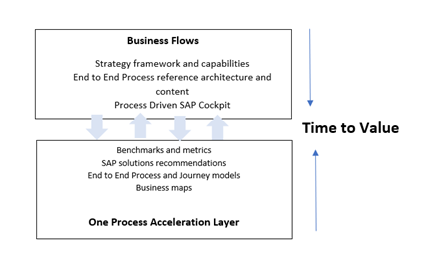
Fig. 1 Mapping concept

Fig. 1 shows how we map Business Flows objects to SAP’s content. Let me explain which key elements our framework provides and how they link:

Strategy Framework and Capabilities

Our current strategic framework is based on the idea that companies should identify their core objectives based on SCOR performance metrics (Business Drivers) and link these to the relevant Business Capabilities, as well as their scoped E2E scenarios. Our framework supports this exercise because we have already mapped the Business Drivers to our E2E scenarios and a set of Business Capabilities.

SAP’s content that is now in beta offers insights into the various solution capabilities. We have therefore re-mapped SAP’s Business Capabilities to our Business Drivers and where possible directly to the E2E scenarios. This allows the users to identify which SAP capabilities and solutions best help them achieve their goals and create a high-level solution architecture. With the January 2023 release, SAP will also be delivering its own business drivers, connected to business capabilities, including metrics and best practice content to deliver top to bottom, strategy to execution.

E2E process reference architecture and content

Business Flows offers a comprehensive set of E2E scenarios based on a process library. The scope of the processes covers the typical use cases within industrial companies. All scenarios are organized according to their E2E - Domain (i.e., Order-to-Cash, Procure-to-Pay) as well as a scenario cluster which is a collection of scenarios of a specific topic (i.e., consignment, replenishment etc.). Each scenario consists of a value chain of business processes and interfaces to other scenarios. The whole content is consistent and can be used to scope and rapidly set up a company specific repository. The granularity of our business processes is aligned with SAP's libraries, therefore they fit very well to the value chains provided by SAP's industry content. The industry content is organized into collections such as 'AMG' for Automotive Manufacturing or 'OTC' for the Chemicals Order-to-Cash scenarios. We have created and included a scenario cluster for each of these groups and within the cluster we list each scenario with a link to the original content (see Fig. 2). This allows users to discover the industry specific content and include it in their scope, if suitable. Of course, taking an SAP scenario into scope requires transferring the relevant content into the customer repository and re-establishing the process repository’s consistency. Rebuilding a consistent Business Process library is anyhow a necessary task after scoping and a standard step within our approach.

Fig. 2 Plan to Produce End-to-End scenarios with reference to SAP HCO content

SAP Best Practices

As part of the content provided by the One Process Acceleration Layer, the scope of the solution (e.g., SAP S/4HANA) can be defined with so-called Best Practices (Scope Items). We believe that these Best Practices as defined by SAP have a great value during the process design phase. They help identify Best Practices which can be included into the solution. In Business Flows we have mapped the Best Practices to our repository. The nature of Best Practices, especially the variance on granularity, resulted in a mapping on various levels but mainly on Process Group or E2E scenario level.

Similar to the approach mentioned above, we only transfer the selected Best Practices into the customer repository and ensure a consistent repository. This consistency is especially important when the content is synchronized to the Solution Manager for the sake of solution documentation, test management or using focused build.

Process Driven SAP Cookbook

Walking the talk of SAP Activate and leveraging the content of SAP’s reference content in a Business Transformation initiative does not only require building up a process repository with the artifacts mentioned above. To ensure the 'process driven' approach, it requires coordinating many activities to refine and use the content in a consistent manner across the whole lifecycle.

To guide customers through this process we have created a Process Driven SAP “Cookbook”. In itself, this is a model in SAP Signavio (Fig. 3) which contains all work packages related to the SAP Activate Phase and Stream. They include descriptions of the key activities, involved roles, outcomes and especially guidance on which artifacts of the process repository are used or created.

Fig. 3 Business Flows Cookbook ‘Process driven SAP’

Conclusion

Our current investigation is based on the beta version, and we know that the general availability for SAP Signavio Process Explorer and the related One Process Acceleration Layer practices is actually planned for January 2023 with more content and value accelerators such as performance-driven scenarios being delivered. Nevertheless, even in its current beta state, the SAP’s approach with One Process Acceleration layer providing reference and best-practices content is a great step forward in fostering a process-driven transformation approach and it really lives up to its claim to ‘accelerate’ a business transformation. We also believe that our offering in Business Flows - a comprehensive business transformation framework with process repository and transformation cookbook – adds further value to it.

Call for Action

Please reach out if you want to have a demo on Business Flows in combination with SAP Signavio.

For questions regarding the SAP’s One Process Acceleration Layer visit the SAP Signavio website (https://www.signavio.com/one-process-acceleration-layer/).

RELEASE PARTY - Business Flows 4 Process Driven SAP - Updates

SAVE THE DATE - 26th November at 09:30 AM CET

Key Note Updates - Release Party

BE OUR GUEST

"Release Party - Business Flows 4 Process Driven SAP ahead!"

Finally! We have now set the agenda for our “Business Flows 4 Process Driven SAP” Release Party. We will have 2 breakout sessions held via Zoom.

Breakout Room 1: Discover & Prepare

How does a Process Driven approach help align transformation objectives with the Scope and Design of your SAP initiative?

Breakout Room 2: Explore, Realize & Deploy

Business Readiness and Change Management. A guided transformation of systems, processes and people.

Due to the positive feedback we had from our Open BPM House Party we will avoid the ‘frontal-webinar’ approach but rather focus on key notes and dialog. This leaves room for an honest, practice-oriented discussion and direct exchange of experiences. So, pick a room and join the conversation which interests you most or switch anytime you feel like it!

Guest speaker at the Release Party will be Mr. Christian Reiter, from msg treorbis, our longstanding partner, friend and the best man for the job to get you FIT for your S/4HANA Transformation.

Face your Challenges! Find Inspiration!

The doors to the breakout rooms will open on 26th November 2020 at 09:30 AM CET.

What you only have to do is:

Register today to reserve your virtual place and receive all the exciting updates!

Come along and join in the discussion with all of us.  

I am looking forward to seeing familiar and new faces.

Sincerely,

Gülsüm Ucuran

Source: https://www.bpexperts.de/release-party-bf4...

RELEASE PARTY - Business Flows 4 Process Driven SAP

SAVE THE DATE - 26th November at 9:30 AM CET

"Release Party - Business Flows 4 Process Driven SAP ahead!"

Face your Challenges! Find Inspiration! It's time to swing into Action. Step up your SAP related Business Transformations. Starting right here. Right now.

We are thrilled to announce the Release of "Business Flows 4 Process Driven SAP". We created Business Flows for Process Driven SAP as a Business Transformation methodology aligned with SAP Activate, but with the addition that it sets a more consistent context to Business Processes across the whole transformation lifecycle.

We open the doors again (virtually) and give you the chance to participate in an honest , practice-oriented discussion with like minded people who experienced the same hurdles as you.

There is something for everyone, for now, this much I can reveal.

To join, please add yourself to the guest list.

Further event details to follow.

Sincerely,

Gülsüm Ucuran