Management Systems and Business Process Management: A golden combination?

By Invitation: Caspar Jans - Senior Director Business Transformation, Software AG

Caspar Jans will be a keynote speaker on our Business Transformation Day on the 10th of November. In this contribution, he shares his views on the - more than ever - relevance of BPM (and BPM tools such as ARIS) in the context of current management challenges. For more information on the agenda, speakers, and experts of the round table session follow this link.


The concept of the “License to Operate” is all too familiar for the manufacturing industry. This means that companies very often need to prove that they are in control of the processes that they are executing. Just take the example of a chemical plant (I’ve worked in this industry for 15+ years): it is crucial that the plant operations department has a very tight grip on all the things that go on in and around a plant. One runaway process can cause severe damage, not only to the plant itself, but also to the surroundings and if such a plant is located close to urban communities it is not too complicated to imagine the enormous potential damages.

Governments and external authorities have established guidelines and requirements for certain industries to make sure that there is a certain amount of predictable reliability of running such a plant without problems. This concept is called the license to operate and nowadays, this concept is no longer only applicable to the manufacturing industries, but also to others.

One major part of the LTO (License-to-Operate) is the Management System, a central place where all relevant process descriptions, procedural instructions and pre-requisites are stored and managed. Very often this repository of knowledge is owned by the Quality Management department and was, and often still is, limited to the production facilities of an organization. The Management System was the vault in which all reviewed, approved, and valid documents were stored, and it acts as the basis for external audits.

On the other hand, over the course of the last 30 years we have seen the development, rise (and fall) and resurgence of Business Process Management, which is a management philosophy based on the construct of a business process that unites and unifies all relevant organization entities (think about people, activities, inputs, systems, risks and controls and much more) into one comprehensive, connected, and aligned view.

Where, back in the ‘90s and early ‘00s, the focus of BPM was quite heavy on the process modeling (or process documentation), we are now witnessing a shift in focus to the facilitation of transformation, optimization, and control of the organization’s execution of work. It is about making sure that the strategic targets are translated into an operating model and detailed out into value chains (end to end preferably) and single business processes, rather than making sure every process is documented to the nth degree of granularity.

The capabilities a decent BPM platform (like ARIS) has, turns out to be a near perfect match for the requirements companies have for their Management System. Focusing both on recording what needs to be done, making sure every relevant employee can consume it and preferably provide insight in the compliance employees show regarding the standards (think about process mining and integrated dashboarding).

Join us as Caspar Jans shares his visionary view of the evolution of the process world in terms of the relevance of BPM as well as insight into “how an Enterprise Management System can help you steer through these challenging times!”.

Register today!

Visit our Business Transformation Day and meet Caspar Jans in person at Schloss Krickenbeck.


Operating Models and Business Flows

Key Messages

  • Engaging business people in the process design and ensuring their buy-in requires starting with building the business context. This is where Operating Models prove their value.

  •  Defining Operating Models is especially essential when designing business processes for complex organizational setups and customer interactions (i.e. cross border, inter/intra-company, third party etc.).

  •  Operating Models are created during the process design phase and are used to support the implementation and change management during build phase and roll-outs.

Mind the gap!

“Which gap??” you would be tempted to ask. Well…WHAT do you do? What is your business? How do you operate, and can you explain this to your IT frenemies or to the outside consultants managing your system integration? How do you build and maintain a mutual understanding of the fit between processes, IT systems and your operations throughout your business transformation? Does everyone know WHY and WHAT you must change to deploy your strategy?

How Operating Models bridge the gap between process design and business operations

From our extensive experience managing transformation projects, we can say that there is a “missing” link between process design and business operations. This missing link can put a strain on transformation initiatives, and it can either increase their cost exponentially, delay them or in worst case scenarios, completely derail them. We help you avoid these dangers with a structured methodology and approach.

Definition

In their most basic form, Operating Models dictate where and how critical activities are performed across an organization. In the context of a business transformation, an Operating Model is the blueprint for how resources are organized in enterprise entities and how they should interact with each other to achieve the strategic objectives of the business. Operating Models therefore show the execution of business processes across different enterprise structures including all involved business partners (vendors, customers).

Operating Models in Business Flows

Business Flows, our business transformation framework, offers a unique process and model driven approach, which combines the use of End-to-End business processes (scenarios) and Operating Models as the main blueprint for transforming an organization. Enterprises using Business Flows for their transformation are provided a comprehensive toolkit (Business Transformation Cookbook) to bridge their strategy, process design, and mode of operations. In this methodology, Operating Models are the missing link and serve as the linchpin between strategy, the implementation of said strategy, and execution.

Methodology

In Business Flows an Operating Model is defined by a set of flows. Each flow distinguishes the exchange of information, material, service, or value between a “sending” and a “receiving” enterprise structure. These flows are accomplished with the help of business processes, hence every flow in the context of an Operating Model can be linked to an End-to-End scenario and/or business process. We take all the flows, including the related information, the involved organizational units, and business partners and create an object-relation model which is embedded in the process repository.

Fig. 1 Example visualization of an Operating Model

Example

It is important to understand that companies typically require several Operating Models. Each Operating Model may have the same business model as an objective (e.g., after sales repairs as a service) but will vary heavily depending on the complexity of the involved enterprise structures and their organizational and geographic characteristics. Simply speaking, the more “boundaries” the flows must cross, the more complex the Operating Models become, and the more complex the required business processes typically are.

A simple example (Fig. 1) is the difference between providing services to customers within a country or to customers outside of the country. In this example regular customers inside the country don’t have to initiate a pick-up repair order because a regular pick-up service is provided (Milk run) whereas companies outside the country do.

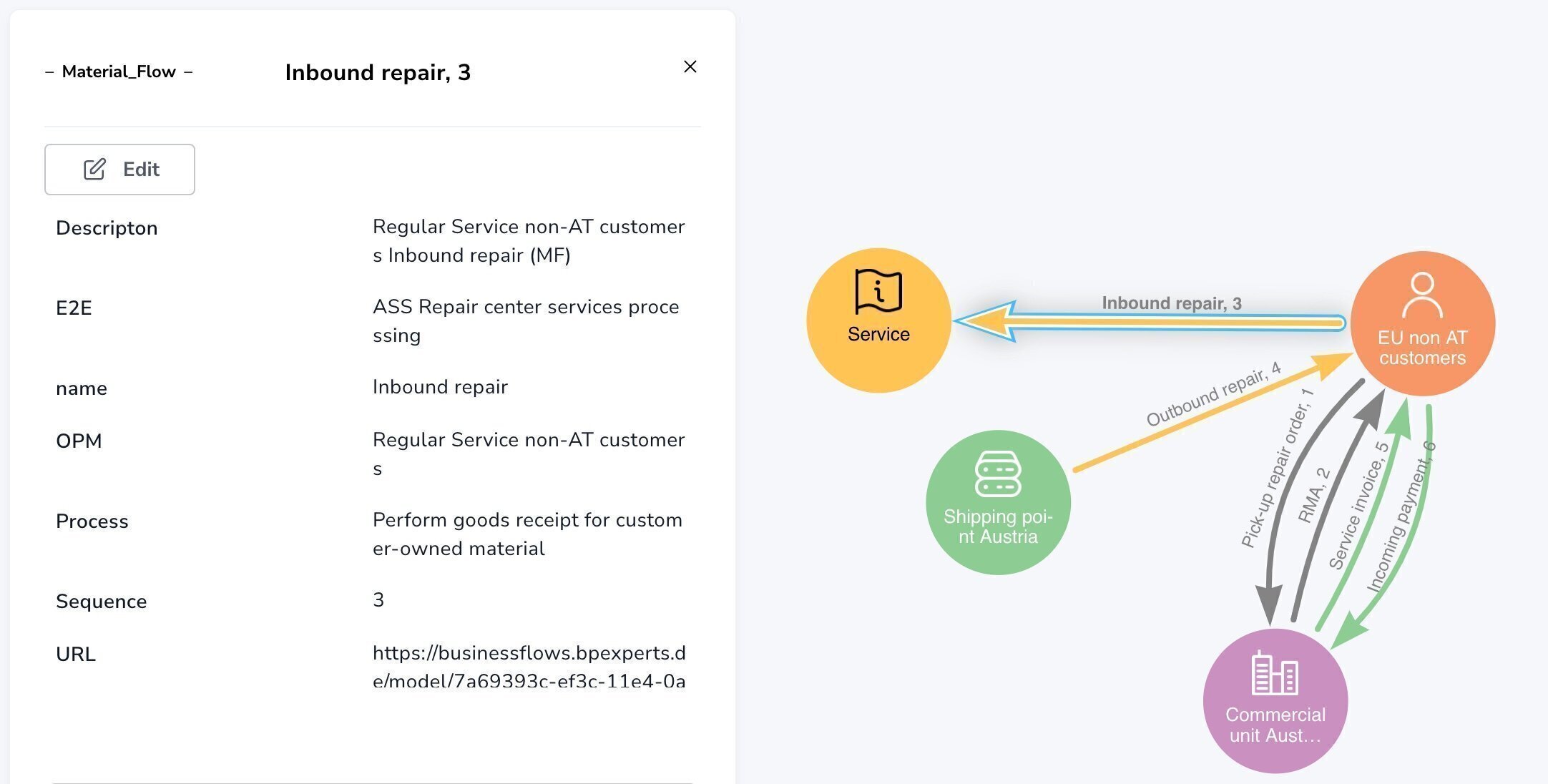
After the Operating Models of the above mentioned example are created we can now filter and drill down into the specifics. In the Fig. 2 we have filtered the model for the “EU non AT customers” and all its flows. You see two Material Flows (inbound to the Service Center and outbound from the Shipping Point) as well as Information and Value Flow interactions with the Commercial Unit. In this perspective the intercompany flows (i.e. the material flow between Service Center and Shipping Point) have been deliberately hidden although they are included in the model.

Fig. 2 Operating Model and selected Material Flow attributes

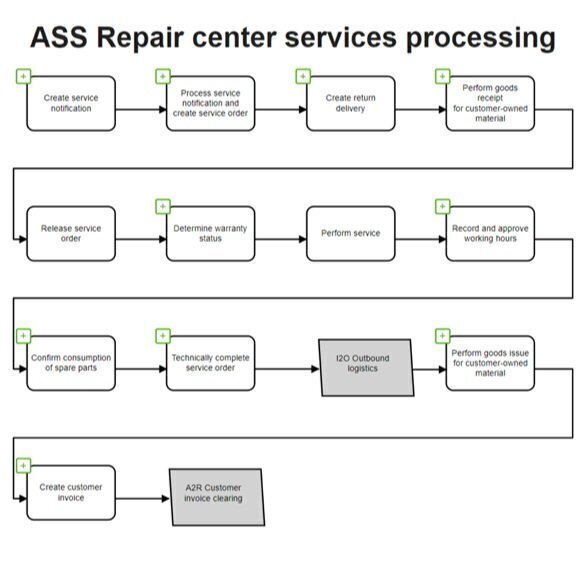
Fig. 3 End to end scenario and Business Processes

Fig. 2 also shows the attributes of a selected flow and its linked business process (Perform goods receipt for customer-owned material) as well as the relevant End-to-end scenario (ASS Repair center services processing Fig. 3). Navigating via the URL to the End-to-end scenario allows us to validate each process against the specific sequence of interactions of the operating model. In this example, it would be interesting to check if the I2O Outbound logistics process fulfills all requirements for the cross border shipment (Fig. 2 - Material Flow ‘outbound repair’).

Uses and benefits 

Using our Operating Models bridges the gap between business and IT by facilitating the communication and creating the synergy between your strategy, its implementation and execution. They support the implementation and change management during build and roll-outs, hence adding considerable value to the success of your Business Transformation. You will be able to create a common understanding of how it all (people, processes and technology) fits together. The Operating Models help you communicate the WHY and the WHAT you are changing to internal and external stakeholders at various instances along the transformation lifecycle for:    

  • Supporting the business case for the ERP transformation project 

  • Scoping and process design

  • Validating process models against ‘real world scenarios’ 

  • Conducting fit/gap workshops 

  • Defining subsets of E2E scenarios and processes to fit certain template shapes / roll-outs 

  • Deriving test scenarios 

  • Analyzing all use cases related to specific E2E scenarios  

Call for action

At bpExperts we work with you to embed the capabilities for continuous transformation into the fabric of your organization. If you are interested in learning more about how to ‘close the gap’ in your transformation approach reach out to us. Independently if you are at the beginning of your journey or if you are already “in the middle of things”.

A special occasion to learn more is our Business Transformation Day on the 10th Nov. 2022. Alternatively request a free demo anytime.


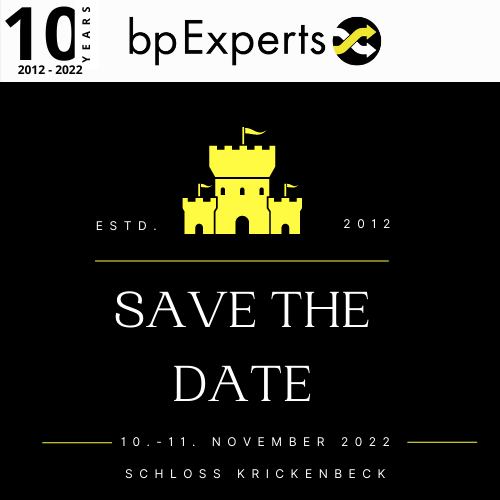
Save the Date: 10. - 11. November 2022, Business Transformation Day

Gülsüm Ucuran

It's that time again. Let's get together.

After a Covid break of two years, we have decided that we would like to continue our annual event in the same successful manner as before.

Our team has been thinking carefully about whether this is feasible and whether we can provide the best setting for it.

And yes, we can!

Now it's just a matter of saving the date.

We hereby cordially invite you to our Business Transformation Day 2022, and to our 10th anniversary at Schloss Krickenbeck in Nettetal on November 10.

We would like to discuss current Business Transformation topics with you and expand into celebrating this very occation. A great evening event is just the right setting for it! Let us surprise you!

On the morning following the conference (November 11), we offer you to make appointments for deep-dives with peer participants and our key experts.

But enough is revealed.

More information after the summer break will follow!

For now, save the date! Register here

Many thanks and kind regards,

Gülsüm Ucuran

Welcome to our Care Club! – We care, we act, we deliver.

- Matej Buzinkai & Merle Steinkamp

Health initiative supported via insa Gesundheitsmanagement GmbH and mobil Betriebskrankenkasse

With our Care Club at bpExperts we want to highlight on one of our three core promises:

“We care, we act, we deliver!”

We care. We care about us, our colleagues, our team and of course our customers. With the Care Club initiative, we aim as a team to focus on promoting health and ensure health long term.

With the Care Club we want to create and provide a range of tools and support mechanisms to  promote and ensure health, well-being, and motivation of each individual so that we can continue to perform healthy and wholehearted in the demanding field in which we want to work.  

We are working on this with our strong partner, insa Gesundheitsmanagement GmbH with their 15 years of experience as a service provider in occupational health management they accompany our endeavor by providing us with tools and knowledge to continue to work on a culture that jointly drives change, shapes our organization together and where we show consideration for each other. Furthermore, mobil Betriebskrankenkasse is sponsoring our initiative.  Care Club was founded as a reflection of our company values. Simultaneously, it helps to strengthen them even more and supports awareness of them.

bpExperts Company Values

Care Club is still new and would need the support of each member of the team so that together, we keep bpExperts a pleasant and vibrant place to work. The most important way how each of us can be a contributing member of the Care Club is to be open to both ask for help and provide help to others, whether it is a simple task or a difficult life situation. 

At the same time, we want to provide the tools and advice to improve our own resilience and improve the way we handle stress, in order to have more energy to enjoy both our work and off-work activities. In Care Club, we create our own health toolbox, which means that everyone is encouraged to ask for an activity or a training that they think would benefit their own health and the health of their colleagues and friends.  

Care Club – only for members! – This means that everyone is automatically part of our club, if they  are employed by bpExperts. The activities are freely available to all of us, always on a voluntary basis. 

Many thanks to our supporters, sponsor and employees.