
BPM Bits & Business Flows #1: Why Most Product Ideas Never Reach Execution

We are officially launching our new weekly series to deconstruct the architecture of modern business! Every Monday, we share one expert insight from the bpExperts Framework to help you eliminate silos and turn raw data into actionable intelligence.

Over the coming weeks, we will be moving through the different SAP domains, specifically tailored to the unique challenges of the process industry.

Today we are getting started with the Idea to Market Domain.

Did you know? Within our Business Flows framework, the journey from a raw concept to a market-ready product is protected by Standardized Stage-Gate Governance.

The Expert Deep Dive: In capital-intensive sectors, organizations often face "innovation leakage" or misaligned investments. Our framework addresses this through four critical front-end checkpoints: Identify, Assess, Select, and Define. This structured control acts as a strategic gatekeeper, ensuring that every project is validated against strategic alignment and risk-adjusted evaluations before significant resources are committed.

Why it matters for bpExperts:

  • Eliminates Silos: By integrating these gates, you ensure that Design, Finance, and Manufacturing are aligned from day one.

  • Operational Integrity: It serves as a checkpoint that prevents unauthorized spending and ensures execution readiness.

  • Value-Driven Execution: It moves the business from subjective guessing to data-driven decision-making, ensuring only the most viable projects proceed.

As noted in our layout, organizations that adopt these BPM practices improve operational efficiency by providing end-to-end visibility and reducing bottlenecks.

Master the Flow: Join us every Monday as we bridge the gap between high-level strategy and operational excellence across the Process Industry landscape! Discover more about our methodology here: https://www.bpexperts.de/business-flows

Next Monday, we move from the 'Gatekeeper' to the 'Cost-Counter'. We’ll be looking at why a product design in the Idea to Market flow isn't actually finished until the finance team sees the standard cost estimate.
From Pipe to Brain: Rethinking Signavio–CALM Integration with AI-Native Architecture

At bpExperts, we often see organizations successfully connecting SAP Signavio with SAP Cloud ALM — but still struggling to turn that connection into real insight. The typical setup works, yet remains fundamentally limited.

Process models are synchronized, fit-gap analyses are carried out externally, and meaningful insights are created manually. In essence, the integration acts as a pipeline for data — not as a system for understanding.

This raises a simple but important question:
What if your process architecture could do more than just store information? What if it could reason?

From Integration to Intelligence

To move beyond this limitation, we built an AI-native Business Framework Knowledge Graph. Instead of exporting process data into static structures, the entire architecture is represented as a connected system within a Neo4j graph.

Processes, capabilities, SAP scope items, and even AI use cases are no longer isolated elements. They become part of a living structure where relationships are explicit and can be explored dynamically.

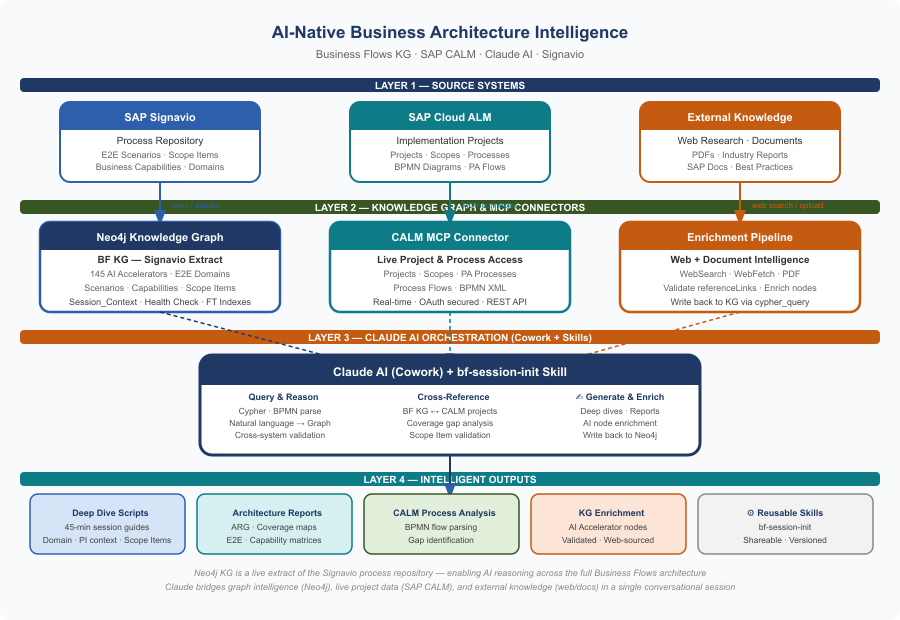
At the same time, SAP Cloud ALM is connected directly, providing access to live project data, scopes, and BPMN models. This creates a continuous link between architecture and execution.

With AI embedded into this setup, the system can not only retrieve information but also analyze relationships, identify inconsistencies, and generate insights across the full architecture.

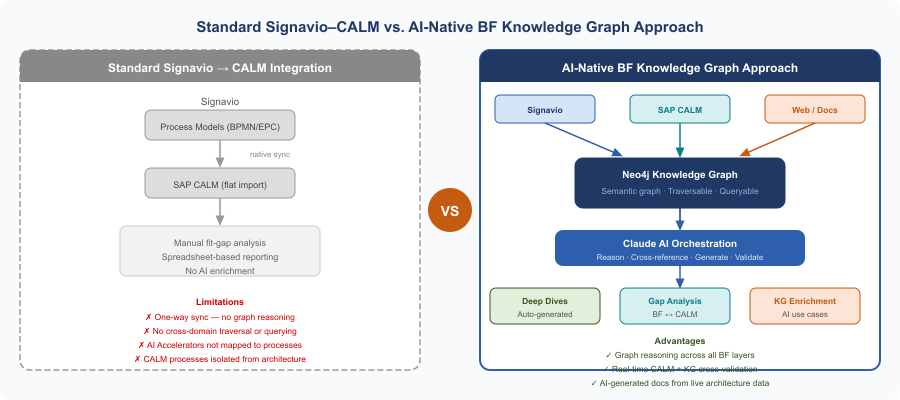
The difference between a traditional integration and an AI-native architecture becomes clear when visualized:

Instead of a linear flow of data, the architecture becomes a connected system where relationships can be explored and analyzed in real time.

What Changes in Practice

The impact of this approach becomes clear very quickly. Instead of working with static exports and disconnected analyses, teams can interact with a live, queryable architecture.

Questions that previously required manual effort across multiple tools can now be answered in real time. Gaps between intended architecture and actual implementation become visible immediately. Process models can be interpreted in context, not just viewed in isolation.

In practice, this setup creates a tightly integrated environment across process architecture, implementation, and AI-driven analysis:

This allows teams to move from static documentation to dynamic interaction with their process landscape. Even complex deliverables such as deep-dive analyses or architecture documentation can be generated directly from the underlying data, ensuring consistency and significantly reducing effort.

A Shift in Perspective

The key difference is not technical, but conceptual.

A traditional Signavio–CALM integration acts as a pipe. Data moves from one system to another, but understanding remains external.

A knowledge graph-based approach acts as a brain. The architecture becomes something that can be explored, questioned, and reasoned over.

As a result, the nature of the questions changes. Instead of asking what is in scope, organizations can start asking what is missing, where overlaps exist, and where the greatest value can be created.

Looking Ahead

This approach is only the starting point. The next steps focus on strengthening the connection between architecture and execution, enabling bi-directional synchronization, enriching the graph with additional data sources, and generating insights directly from live project activity.

Final Thought

This is what AI-native BPM looks like in practice. Not an additional layer on top of existing tools, but intelligence embedded directly into the architecture itself.

bpExperts Employee Spotlight: Working Across Borders with Veronika Hein

Welcome to the very first episode of bpExperts Employee Spotlight—a new series dedicated to introducing the people behind bpExperts. In today’s interconnected world, working in an international environment presents both challenges and exciting opportunities. In this edition, we shine the spotlight on Veronika Hein, a Senior Consultant at bpExperts, who shares her journey and experiences in this dynamic, global setting.

With more than two years at bpExperts, Veronika has embraced the diversity and complexity of her role. Her work spans business transformation projects and change management initiatives across different regions and cultures, making adaptability and openness key to her success.

Embracing Diversity and Continuous Learning

One of the aspects Veronika values most about her role is its ever-changing nature. “Every day is different,” she explains, highlighting how variety keeps her motivated and constantly learning. One of her most memorable experiences was a year-long merger project involving two companies. During this time, she collaborated closely with colleagues from Asia Pacific, Europe, and the United States.

This project not only strengthened her professional expertise but also deepened her appreciation for cultural differences and communication styles—an essential skill in today’s global workplace.

The Advantage of Remote Work

Remote work plays a significant role in Veronika’s professional life at bpExperts. Living in a village, she values the flexibility of working from home, which allows her to maintain a healthy balance between her professional and personal life. While coordinating across multiple time zones can be challenging, Veronika has learned to manage this effectively by setting clear boundaries and prioritizing her tasks.

The Power of Teamwork

For Veronika, the most rewarding part of her job is the team. Working alongside colleagues from diverse backgrounds creates an environment rich in learning and collaboration. This diversity encourages fresh perspectives and innovative problem-solving. The strong sense of teamwork at bpExperts helps tackle challenges together and fosters a culture that truly feels like a family.

Looking Ahead

Veronika’s story highlights the benefits of working in a global and remote environment. Her experience at bpExperts underscores the importance of diversity, adaptability, and teamwork in today’s professional world. As she continues to grow in her role, Veronika remains committed to learning and evolving alongside her colleagues.

Stay tuned for more bpExperts Employee Spotlights—featuring the people who are the heart of our company.

Business Flows 2.0 Release Overview: From Generic Foundations to Industry-Specific Execution

bpExperts is proud to announce the latest Business Flows 2.0 (BF 2.0) release—a structured, SAP-aligned repository of business processes designed to support real-world SAP transformation initiatives.

This release delivers value in two distinct ways. It enhances the Generic Industry version with improved structures and updated content, and it introduces a new Process Industry repository tailored specifically to the operational realities of process-driven organizations.

With Business Flows 2.0, organizations gain greater transparency across their process landscape, faster and more reliable process scoping, and actionable insights that accelerate SAP-driven transformations from the earliest phases. The BF 2.0 release is guided by a consistent set of principles applied across both the Generic and Process Industry content, ensuring that improvements are not isolated changes but part of a coherent overall design.

What Makes This Release Special

A defining element of this release is the enhanced Business Flows metamodel, which introduces industry-specific transformational drivers and business capabilities that are explicitly modeled and visible:

  • Carefully selected, industry-relevant end-to-end scenarios were defined for the Process Industry, focusing on real operational business cases rather than generic functional flows.

  • Industry-specific transformational drivers and business capabilities are explicitly represented, making the link between strategic objectives, processes, and execution transparent and actionable.

  • For the first time, SAP scope items, business capabilities, and SAP solutions are officially introduced and implemented together, ensuring that process content is directly aligned with what SAP solutions support in practice.

👉 Request a demo session to explore Business Flows 2.0 and see how industry-specific process content can accelerate your SAP transformation.

Process Industry Development Approach

As part of the BF 2.0 release, a dedicated Process Industry (PI) version has been introduced. It complements the Generic Business Flows by providing tailored structure and content for process-driven organizations and serves as a blueprint for future industry-specific releases.

SAP-Aligned Domain Coverage

The Process Industry repository spans eight SAP-aligned end-to-end domains:

  • Idea to Market

  • Plan to Fulfill

  • Lead to Cash

  • Source to Pay

  • Finance

  • Acquire to Decommission

  • Governance

  • Recruit to Retire

Objectives of the Process Industry Release

The objective of this release is to enable effective scoping, design, and implementation of SAP-aligned business flows by:

  • Establishing a comprehensive, industry-specific process repository

  • Deploying the content on SAP Signavio for immediate use in modeling and analysis

  • Supporting efficient mapping of real business cases to SAP solution capabilities

  • Highlighting process-industry-specific transformational drivers and business capabilities to support targeted business outcomes

Development Methodology

The Process Industry content was developed using a structured and reusable approach:

  • The Generic Business Flows served as a baseline to ensure architectural consistency

  • Industry-specific business cases (such as Sell-from-Stock, Third-Party Procurement, and Manufacturing Site operations) defined the primary scope

  • Industry-centric scoping focused on operational realities rather than functional decomposition

  • Validation against SAP solution capabilities ensured feasibility and alignment

  • Dedicated libraries of transformational drivers and business capabilities support measurable value realization

Repository Structure and Benefits

The Process Industry repository provides multiple perspectives to support navigation and analysis:

  • Industry View for selecting relevant content

  • Domain View aligned to SAP end-to-end domains

  • Industry-specific E2E scenarios and transformational drivers

  • Detailed E2E flows linked to business capabilities and SAP scope items

This enables organizations to:

  • Accelerate process scoping and design using predefined industry standards

  • Align business processes directly with SAP solution capabilities

  • Identify key transformational drivers and required business capabilities

  • Maintain a consistent, structured, and reusable process repository

Generic Industry Highlights

The Generic Industry version has also been significantly enhanced in this release, with improved domain structures, refined end-to-end scenarios, and stronger alignment with SAP solutions.

Key improvements include:

  • Introduction of Acquire to Decommission and Asset Management, completing the full asset lifecycle view

  • Structural realignment based on Integrated Business Planning principles

  • Streamlined end-to-end scenarios, removal of obsolete content, and introduction of new scenarios addressing regulatory, sustainability, workforce management, and subscription-based business models

This release incorporates SAP scope items version 2508, with extended coverage across logistics, procurement, asset management, finance, quality management, and human capital management. SAP Integrated Business Planning, SAP Ariba, and SAP SuccessFactors scope items are aligned where applicable.

Several domains remain under active review and will be further enhanced as part of planned redesigns scheduled for Q1 2026.

Overall Impact

Overall, this release strengthens the foundation of Business Flows 2.0 by improving structural consistency, expanding functional coverage, and ensuring closer alignment with current SAP solutions and best-practice operating models.

Business Flows 2.0: Why Industry Context Matters More Than Ever in SAP Transformations

Over the past years, we have used Business Flows in many SAP transformation initiatives — especially in large, complex industrial environments. And while the feedback has consistently been positive, one insight became impossible to ignore:

👉 Reference content only creates value if it is scoped, relatable, and usable from day one.

That insight is the starting point of Business Flows 2.0.


From “One Size Fits All” to Industry-Specific Acceleration

In earlier releases, Business Flows followed a deliberately generic approach: a comprehensive set of end-to-end scenarios covering all industries, all domains, all variants of doing business.

That worked—until it didn’t.

As the content grew, we saw a clear pattern in projects:

  • Scoping workshops became harder

  • Repositories became overwhelming

  • Teams spent too much time reducing instead of accelerating

With Business Flows 2.0, we have added a fast lane:

➡️ Industry-specific repositories, curated and pre-scoped for real transformation work.

Aligning Business Architecture with SAP Reference Content

Another strong driver behind Business Flows 2.0 is the way SAP has evolved its own reference content over the last years.

SAP Best Practices, Scope Items, and Solution Capabilities have become extremely rich—but also complex. What’s often missing is a business-oriented structure that helps organizations understand:

  • Why certain capabilities matter

  • Which scope items are relevant

  • How they relate to real end-to-end business scenarios

Business Flows 2.0 bridges exactly that gap:

  • Business end-to-end scenarios remain the anchor

  • Transformation drivers make objectives and pain points explicit

  • Business capabilities connect strategy to execution

  • SAP solutions and scope items are mapped transparently—without losing the business perspective

One Domain. One Map. One Conversation.

A major structural change in Business Flows 2.0 is that we no longer separate:

  • End-to-end scenarios

  • Process groups

  • Process libraries

  • Transformation drivers

into disconnected entry points.

Instead, they now come together within one domain map.

That means:

  • No jumping between different models

  • No loss of context

  • Much faster conversations with business and IT stakeholders

It’s a setup designed for the Discover and Prepare phases of SAP initiatives—before teams disappear into detail.

First Release: Process Industry (Discrete Manufacturing Next)

We’re starting the Business Flows 2.0 journey with the Process Industry domain, released today.

Discrete Manufacturing is already in progress and will follow shortly. From there, we’ll move into Consumer Goods—and later into industries where the differences are even more substantial, such as Retail, Utilities, Energy, and Services.

That’s where the industry-specific approach will really shine.

Transparency Is Still Our Philosophy

One thing hasn’t changed.

We’ve always believed that reference content only creates trust if it is transparent, consistent, and open for discussion. That’s why we’re happy to:

  • Walk you through the content

  • Give you access via our collaboration hub

  • Discuss how it fits (or doesn’t fit) your transformation context

Because at the end of the day, Business Flows is not about models.

It’s about helping organizations enter and execute SAP transformations with clarity, structure, and speed.

If this resonates with you, feel free to reach out—we’re happy to continue the conversation.

👉 If you want to see how this looks in practice, reach out to us and get your free demo session!