Process-driven Business Transformation: Achieving process, system, data, and people readiness with one methodology

Markus Wolf

A holistic readiness for transformation requires structures weaving together the areas for readiness of processes, systems, data, and people. Tying it all together into one methodology allows for project specific customization of the approach by program and project management while ensuring consistency and transparency.

The readiness idea and process focus

Processes are at the center of every business transformation. They facilitate well-structured discussions and decision making, as well as training and communication. The aim is to link the company strategy, operating models, and targets of the transformation to the to-be design, as well as required system support, and data. The intended future state and necessary adjustments are made easy to understand for various stakeholders.

Getting people to understand processes, systems and data in their daily context creates business readiness. That is what we do as Business Integrator. 

Our methodology ensures senior stakeholder buy-in and process understanding early in the transformation by covering the business drivers and operating models of their business and linking those to harmonized standard core processes. 

The readiness idea and system focus

Having established clear strategic targets broken down per process area allows process owners and experts to determine requirements and changes both on business, as well as system perspectives. Requirements can be translated directly into solution design in context with the envisioned future state of business operations.

Offering guidance along standard processes, best practice, and system expertise protects the integrity of the solution design. The amount of system customization can be limited to where it is required to achieve the targeted strategic benefits.

Early contributions and decision-making responsibilities of process owners and experts lead to in-depth understanding of targets and design, to intensive knowledge build-up within the customer organization and fosters later acceptance of changes.

The readiness idea and data focus

Data, and especially master data represent the link between the various business cases and the applicable business processes, and consequently processing within the solution design in a highly automated and digitalized world. It is hence pivotal to establish already throughout the design and transition a widely shared understanding of how data steers processes and functionality.

The readiness idea and people focus

Discussing and elaborating on business processes naturally leads to identification of impacted organizational areas, and to an early assessment of change impacts on the daily operations and on core business KPIs. It also allows for a clear location of changes, thus providing a sound basis for planning and preparation of the actual implementation of adjustments. Furthermore, the structured and interlinked documentation of change impacts enables identification of essential business and design decisions.

Over time objectives might change and adjustments to the design must be made for several reasons on all levels. We enable the orchestration of changes by efficiently documenting all transformation aspects, including business and design decisions in an interlinked and comprehensive manner.

We believe in these re-enforcing factors of our process-driven business transformation methodology.

Example – business-relevant testing

When using our process-driven business transformation methodology, test cases and test scenarios can be derived directly from the respective flows or underlying operating models, from the related business cases and further connected to the defined End-to-End processes. This already contributes to identifying the relevancy of test cases in combination with pertinent data for the users’ future daily lives. It allows testers, like business key users, to generate valuable insights both for training preparation, but also as feedback for small improvement ideas which can boost acceptance of the solution amongst affected user groups. The reporting on test status can be tailored to the needs of various stakeholder groups. The respective process owners can receive a status for their area of responsibility, like Pl2P, O2C or A2R. Business managers can be provided with details on testing progress for their relevant operating models and core business activities. Reported errors from testing, as well as improvement ideas can be reported directly to the relevant stakeholders. This makes testing results and related information more tangible.

Key messages:

The fully interconnected process-driven business transformation methodology improves understanding of relevancy of the planned transformation on individual level of all stakeholders. As a result, decision making can be accelerated and the quality of decisions can be increased, while fostering an identification with and acceptance of the transformation.

  • It is not sufficient to adress all those aspects individually; you need to tackle them in an orchestrated approach across all stakeholders and throughout the whole transition period

  • Your business transformation vision requires a managed and transparent break-down, and a translation to manifest in people, processes, systems, and data

  • The key for agility and sustainability of your transformation is the capability to coherently reciprocate along the path of intention, decision, and implementation

Call for Action

A special occasion to learn more is our Business Transformation Day on the 10th Nov. 2022. Alternatively request a free demo anytime. 

Business Flows meets SAP's One Process Acceleration Layer

Russell Gomersall


After SAP acquired Signavio and announced the One Process Acceleration Layer for SAP solutions and the corresponding beta program, we were thrilled about the opportunities this may have in store for us.

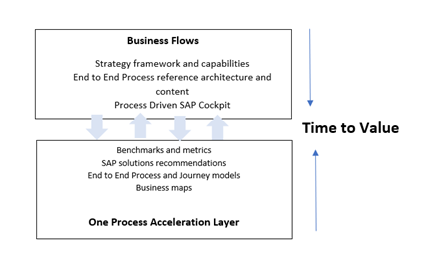
The One Process Acceleration Layer is a practice for better and faster transformations and represents the collective knowledge from thousands of transformation projects SAP delivered over time. This knowledge is conveyed to organizations in the form of value accelerators such as reference business and solution architectures, solution best-practices, business metrics, and thought leadership papers.

At bpExperts our core competence is to support companies in building a process repository including all relevant artifacts and establishing a process driven approach including methodology, required roles, and governance to support the business transformation life cycle.

On its end, SAP’s One Process Acceleration Layer practice will also be driving more organizations to adopt a process driven transformation approach delivering value accelerators which can be explored and consumed centrally, via the SAP Signavio Process Explorer.

From a bpExperts perspective we were anxious about how our Business Flows fits into the equation and can work in conjunction with SAP’s One Process Acceleration Layer practices. Will Business Flows become obsolete with the provision of SAP’s reference content, will it be perceived as a competition or is there a clear added value to be addressed in using both?

After deeply diving into the content and meta-model, we are happy to announce that it is the latter:

We believe Business Flows adds considerable value to customers on their Business Transformation journey and especially in combination with SAP’s content.

Business Flows content has been mapped to One Process Acceleration Layer best-practices so that companies exploring both can find consistency, synergies and added value from a combined use.

Fig. 1 Mapping concept

Fig. 1 shows how we map Business Flows objects to SAP’s content. Let me explain which key elements our framework provides and how they link:

Strategy Framework and Capabilities

Our current strategic framework is based on the idea that companies should identify their core objectives based on SCOR performance metrics (Business Drivers) and link these to the relevant Business Capabilities, as well as their scoped E2E scenarios. Our framework supports this exercise because we have already mapped the Business Drivers to our E2E scenarios and a set of Business Capabilities.

SAP’s content that is now in beta offers insights into the various solution capabilities. We have therefore re-mapped SAP’s Business Capabilities to our Business Drivers and where possible directly to the E2E scenarios. This allows the users to identify which SAP capabilities and solutions best help them achieve their goals and create a high-level solution architecture. With the January 2023 release, SAP will also be delivering its own business drivers, connected to business capabilities, including metrics and best practice content to deliver top to bottom, strategy to execution.

E2E process reference architecture and content

Business Flows offers a comprehensive set of E2E scenarios based on a process library. The scope of the processes covers the typical use cases within industrial companies. All scenarios are organized according to their E2E - Domain (i.e., Order-to-Cash, Procure-to-Pay) as well as a scenario cluster which is a collection of scenarios of a specific topic (i.e., consignment, replenishment etc.). Each scenario consists of a value chain of business processes and interfaces to other scenarios. The whole content is consistent and can be used to scope and rapidly set up a company specific repository. The granularity of our business processes is aligned with SAP's libraries, therefore they fit very well to the value chains provided by SAP's industry content. The industry content is organized into collections such as 'AMG' for Automotive Manufacturing or 'OTC' for the Chemicals Order-to-Cash scenarios. We have created and included a scenario cluster for each of these groups and within the cluster we list each scenario with a link to the original content (see Fig. 2). This allows users to discover the industry specific content and include it in their scope, if suitable. Of course, taking an SAP scenario into scope requires transferring the relevant content into the customer repository and re-establishing the process repository’s consistency. Rebuilding a consistent Business Process library is anyhow a necessary task after scoping and a standard step within our approach.

Fig. 2 Plan to Produce End-to-End scenarios with reference to SAP HCO content

SAP Best Practices

As part of the content provided by the One Process Acceleration Layer, the scope of the solution (e.g., SAP S/4HANA) can be defined with so-called Best Practices (Scope Items). We believe that these Best Practices as defined by SAP have a great value during the process design phase. They help identify Best Practices which can be included into the solution. In Business Flows we have mapped the Best Practices to our repository. The nature of Best Practices, especially the variance on granularity, resulted in a mapping on various levels but mainly on Process Group or E2E scenario level.

Similar to the approach mentioned above, we only transfer the selected Best Practices into the customer repository and ensure a consistent repository. This consistency is especially important when the content is synchronized to the Solution Manager for the sake of solution documentation, test management or using focused build.

Process Driven SAP Cookbook

Walking the talk of SAP Activate and leveraging the content of SAP’s reference content in a Business Transformation initiative does not only require building up a process repository with the artifacts mentioned above. To ensure the 'process driven' approach, it requires coordinating many activities to refine and use the content in a consistent manner across the whole lifecycle.

To guide customers through this process we have created a Process Driven SAP “Cookbook”. In itself, this is a model in SAP Signavio (Fig. 3) which contains all work packages related to the SAP Activate Phase and Stream. They include descriptions of the key activities, involved roles, outcomes and especially guidance on which artifacts of the process repository are used or created.

Fig. 3 Business Flows Cookbook ‘Process driven SAP’

Conclusion

Our current investigation is based on the beta version, and we know that the general availability for SAP Signavio Process Explorer and the related One Process Acceleration Layer practices is actually planned for January 2023 with more content and value accelerators such as performance-driven scenarios being delivered. Nevertheless, even in its current beta state, the SAP’s approach with One Process Acceleration layer providing reference and best-practices content is a great step forward in fostering a process-driven transformation approach and it really lives up to its claim to ‘accelerate’ a business transformation. We also believe that our offering in Business Flows - a comprehensive business transformation framework with process repository and transformation cookbook – adds further value to it.

Call for Action

Please reach out if you want to have a demo on Business Flows in combination with SAP Signavio.

For questions regarding the SAP’s One Process Acceleration Layer visit the SAP Signavio website (https://www.signavio.com/one-process-acceleration-layer/).

Updates! Business Transformation Day 10. - 11. November 2022

Gülsüm Ucuran

Summer break is winding down and as promised, I'm coming back with new updates for our upcoming Business Transformation Day on 10. – 11. November 2022 at beautiful Schloss Krickenbeck.

For all who do not know yet – bpExperts is turning 10 years this year – 10 years of passion for processes, going hand in hand with our annual Business Transformation Day. We would like to celebrate this special occasion in a suitable and exquisite way. So, it is a very special pleasure for us to invite you to our customer day / 10th anniversary celebration.


All good things are worth waiting for!

Finally! We have now set the agenda for our “Business Transformation Day 2022”.

I am happy to announce the following Keynote:

  • How does an Enterprise Management System help you steer through these challenging times?

    Caspar Jans, Senior Director Business Transformation, Software AG

  • ARIS in a hybrid setup. The best of both worlds? Corinna Frank, Head of Digital Processes and Solutions, PHOENIX CONTACT GmbH & Co. KG

  • Carve-Out readiness based on an End-To-End Process house Thomas Göbel, Head of global IT management, Evonik Superabsorber GmbH

  • Enterprise Process Model Development within a Digital Transformation Program

    Sven Gollan, Michael Becker, Team Process Management, Vaillant GmbH


After a lunch break, we will continue in the Krickenbeck’s ‘Rittersaal’ (the knights’ hall), with several roundtables for open discussion, deep-dives and networking with your peers, our longstanding partners and key experts. This leaves room for straight to the point and create jointly new insights.

The Knights of the Round Table with the following topics will be:

Process Driven Business Transformation: Achieving process readiness, system readiness, data readiness, and people readiness with one methodology, Markus Wolf, Stefan Hauenschild

Business Transformation Governance: From change control to transformation enablement, Dr. Dorothee Wenzler, Dr. Jochen König

Mind the gap! How Operating Models bridge the gap between processes design and business operations, Dr. Ikemefuna Allen, Dr. Russell Gomersall, Gabriela Warner

Green-, Brown-, Bluefield? msgFIT helps you to make the right decision! Christian Reiter, msg services gmbh

ARIS rules, OK! Enterprise Management & Process Mining, Caspar Jans, Software AG

Detailed information about the round tables’ topics will follow soon. So, keep checking back and follow us on LinkedIn. But that's not all!

If you didn't find enough time on Thursday and would like to delve deeper into one or the other topic, we offer arranging individual meetings on Friday (11/11). Meet bpExperts members and peers, our partners and key experts.

If this all sounds as exciting to you as it does to us, make sure to secure your spot now!

Come along and join in the discussion with all of us.

Get your ticket now!

Please understand that the number of places is limited, therefore the old rule applies: “First come, first serve!” The participation fees per person are 59,50 € incl. VAT. Exciting presentations with interesting speakers and plenty of time for networking await you. For the evening, a delicious 3-course menu in a stylish ambience is planned. The day ends with a Get-Together and party with DJ to celebrate the 10th anniversary of bpExperts. So, don’t miss it up. The overnight in the “Schloss Krickenbeck” costs 119,00 € incl. VAT including breakfast per person. We ask for binding reservation until 31. October 2022.

More information about the Payment platform for the accommodation, travel accommodation and the event flyer will be sent to the registered participants shortly.  

Please note the Terms and Conditions for Events of the company bpExperts GmbH. Information on the processing, storage and transfer of personal data can be found in our privacy policy.

Please note that photographs will be taken during the day for reporting and public relations purposes by bpExperts.

I am looking forward to seeing familiar and new faces.

Gülsüm Ucuran

Integrated Governance Solutions: From change control to transformation enablement

Governance – the term itself usually splits audiences. For you personally, is governance what slows you down in your agility and throttles innovation or is it the guardrail saving the organization from falling into anarchy and chaos? Well, most of us will stand somewhere in the middle depending on the concrete topic at hand. 

Wiping aside all orthodoxy, current challenges all organizations are facing:  

  • Processes and supporting (digital) tools depend on fast and efficient change in response to internal and market requirements. 

  • Diversification of supply chains and integrated production increase complexity of change projects. 

  • New products require complementing or changing established business models. 

  • Customer expectations regarding delivery time, product quality and service are ever increasing. 

As if that wasn’t enough:  

  • Business operations and change initiatives are competing for the same internal resources. 

  • Key knowledge keepers retire or leave for other reasons. 

  • New talent is difficult to come by and takes time to ramp up. 

Well…yes, feel free to consider this the new normal. So, what can we do about it? 

bpExperts integrated governances solutions provide methods and tools for transformation journeys 

From the current knowledge and perspective several strategic roadmaps might be correct. However, are they still correct in two years ahead? 

bpExperts supports customers through these challenging transformation journeys and provides a methodology and tool set fostering three key aspects: 

  • Transparency regarding responsibility and purpose  

  • Transparency regarding handovers and interfaces 

  • Manifesting ability AND agility to transform business and systems continuously with a customized integrated governance concept 

Transparency regarding responsibility and purpose 

Organizations that are facing transformation activities resulting in a new system landscape, a new core IT system are often overwhelmed with the quantity of alternative solution scenarios. Lucky project teams can base their work on a previous strategic decision, e.g. on a software and supplier.  

Nevertheless, the quantity and complexity of modules, apps, and customized solutions is challenging. Evolved organizational habits and process specific customized solutions in each department or working group are well anchored within each team. Niche solutions are competing with the ambition of enabling end-to-end flows through large integrated systems. 

Figure 1 : Highly integrated process scenarios enable visualization of process, collaboration and system interfaces.

Likely to your surprise, this is exactly where an integrated governance can help. Change project teams require guidance and guardrails to enable their work and shield off distractions and scope creep.  

Transparency on the principal process landscape and architecture with clear roles and responsibilities is instrumental for distributing decision power and implementation action (Fig. 1).  

This does not mean that every project will require the traditional full as-is analysis and to-be design and ‘painting’ hundreds of process charts. Interrogating the organizations’ current process understanding (documented or not) against reference content like Business Flows enables the process experts to accelerate decision-making about must-have processes, those that are nice-to-have, and where it will be worthwhile to analyze and document more deeply.  

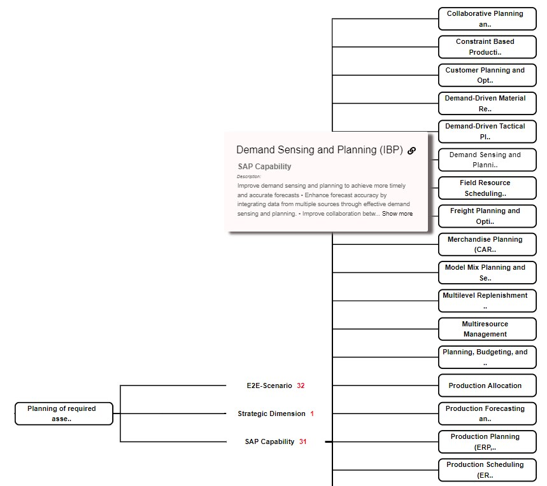
Figure 2: Business Driver and its connection to E2E-sceanrios and SAP capabilities

Not surprisingly, the trick is to focus effort where it is beneficial and cut it where added value is marginal. 

Strategy and Capability maps support strategic decision-making on the management level (Fig. 2) and empower project teams in defining the best suitable solution design within the business process and for the future digitization solution.  

Systematically considering value drivers and business capability filters assure staying connected to the business goals and not getting hung up on technical beauty.  

Transparency regarding handovers and interfaces  

Once the scope and goal are decided and transparent, it is all about enabling implementation and change.  

Integrated governance solutions and associated documentation must be customized to the individual organization and must be suitable to support current and future initiatives. Process models (and conventions) must be flexible to keep up with the changing environment project teams are working in. Overly strict, ‘all processes are equal’ process governance would prevent project teams from using its value in enabling complexity reduction and visualization.  

Figure 3: Factsheet with consolidated EPC/BPMN information

Factsheets (Fig. 3) may be perfectly sufficient for the majority of processes while a focused operational excellence initiative or niche tool implementation may require fine-grained documentation. In a mature concept, each stakeholder group should find value in using processes, not just change control and standards documentation. Governance and oversight are needed to still maintain a cohesive overall model and enable consistent reporting of process content.  

Leveraging reference content, existing documentation, and tools rather than engaging in building documentation from scratch frequently involves connecting domain-specific documentation systems. Integrating Enterprise Architecture and BPM content like we recently showcased for LeanIX and ARIS can help optimize efforts and benefits (Fig. 4)

Figure 4: Customized Entry Map meeting all stakeholder's entry points

With Business Flows and proven capacity and track record of integrating content and methodology across technical platforms, bpExperts is excellently positioned to fuel your initiative. 

Manifesting ability AND agility to transform business and systems continuously with a customized integrated governance concept 

In software development, agile incremental delivery of small-value deliverables is already state of the art.  

bpExperts made a good experience with adopting agile key principles and adapting them to BPM governance. Within this homology, the Process Owner can be seen alike the Product Owner in agile development, with the BPM organization giving methodological guidance alike a Scrum Master. The team is comprised of the Solution Architects, Business representatives, and key users, and specific domain experts, e.g., data privacy or safety, as needed. 

Just as individual agile teams can be scaled to higher orders or coordination so can the continual improvement of ‘atomic’ processes be scaled to larger structures and even whole templates or an organization’s digital twin. 

However, just like in agile development enablement and empowerment, along with strict adherence to the method and ceremonies is instrumental for the success. There is no successful half-hearted agile project and no success in half-baked BPM initiatives. 

Consistent processes architecture forms the integration layer between and across process and domains. This forms the foundation for self-organized BPM teams to find the best system design for the future organization.  

Demo on Demand

At bpExperts as business integrators we work with you to embed the capabilities for continuous transformation into the fabric of your organization. If you are interested in learning more about how integrated governance solutions support your transformation approach reach out to us. Independently if you are at the beginning of your journey or if you are already “in the middle of things”.  

A special occasion to learn more is our Business Transformation Day on the 10th Nov. 2022. Alternatively request a free demo anytime. 
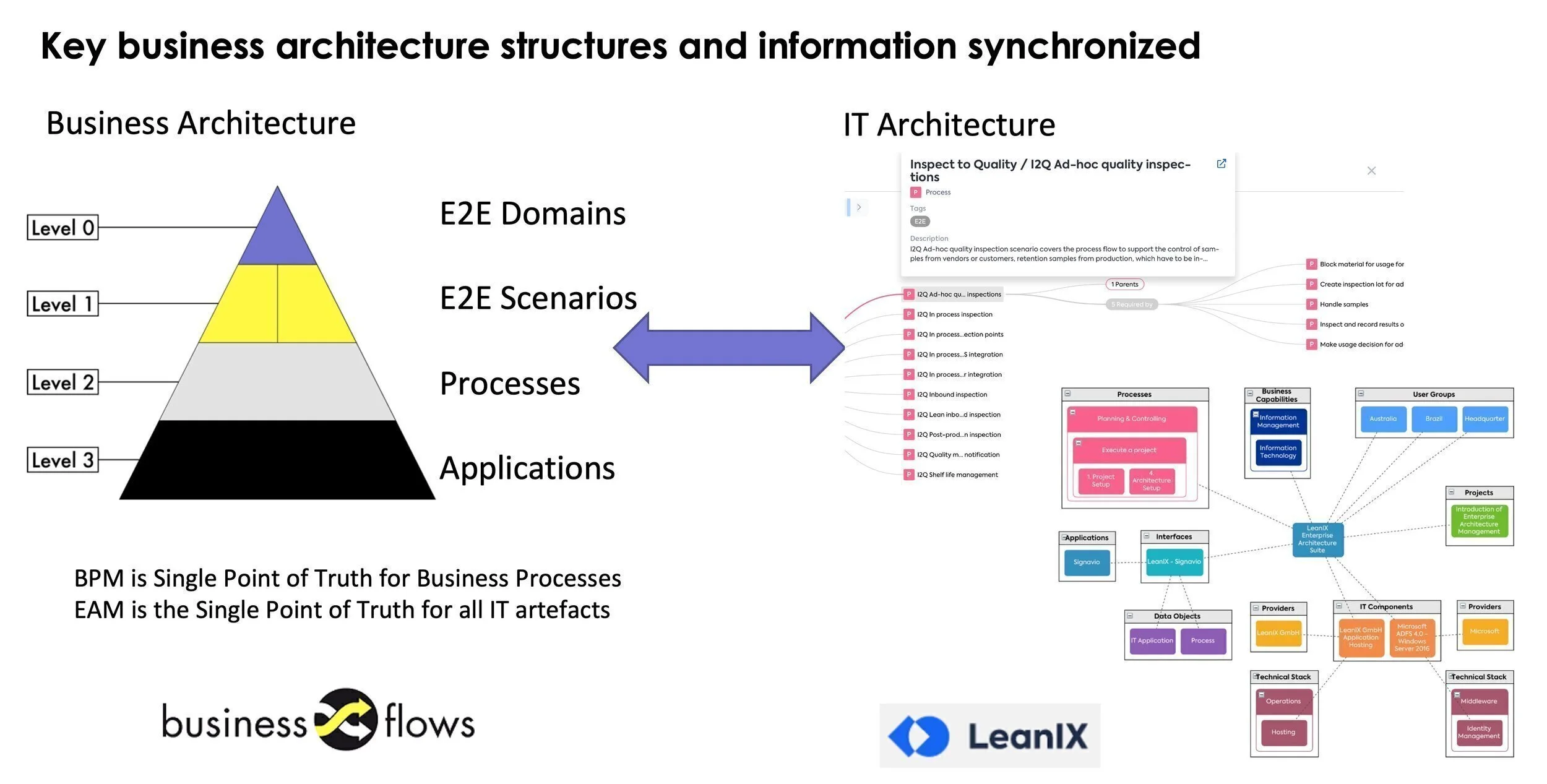
How to integrate the BPM and EAM use cases into LeanIX in the course of your Business Transformation

LeanIX undisputedly is a leading Enterprise Architecture Management (EAM) Tool. The definition of EAM implies considering the whole enterprise. The core purpose of any enterprise is the creation of value for its customers and stakeholders which is based on business strategy, operating models, and business processes. Traditionally however, EAM is used more by IT departments for IT related use cases (such as application lifecycle planning) and as a result the business side of the architecture, the Business Architecture (BA), is mostly only rudimentarily considered in many EAM initiatives.

It is easy to name reasons why this is the case. The main is that defining and managing the BA is often the responsibility of a different department, following their own domain’s methodology (BPM) and especially focusing on other use cases than the IT (Compliance, Lean, OpEx, ...). To achieve this the BPM related use cases require an overarching End-to-End view on Business Processes as well as a very deep analysis of process interactions (BPMN).

Now, especially when a company engages in a large scale (digital) Business Transformation, these worlds belong together and need to work hand in hand.

There are numerous technical approaches for integrating LeanIX with BPM tools such as ARIS and Signavio. However, looking deeper into the topic, only rudimentary integration, misaligned methodology and no 'real' representation of the relevant business aspects in the LeanIX environment can be found.

In my demo I will show how these 'worlds', EAM and BPM, can be brought together and discuss the main points of this aligned methodology.

Introduce End-to-End (E2E) Business Scenarios

One key point is creating an E2E view of the Business Scenarios based on a library of actual business processes within LeanIX. I will show how this can be achieved via a dynamic interface to an external BPM system but also how LeanIX can be used in a 'stand-alone' mode by leveraging our E2E process reference library (Business Flows) in LeanIX. One of the most obvious benefits of having E2E scenarios in LeanIX is the possibility to identify possible business disruptions across functional borders. For example a typical Order-to-Cash business scenario is requires sales, logistics and financial business capabilities and can therefore be dependent on several applications.

Align Business Capabilities and Functional Process library

In an IT Architecture context Business Capabilities are used to structure and standardize the business demand and compare them with existing application portfolios. On the other hand the functional process library is used to structure the functional requirements from a process perspective and manage and standardize existing process variants. We think it makes sense to align these to structures. That means having identically named structures for Business Capabilities and Process Groups and or Clusters (depending on how many levels your hierarchy has). This automatically results in the possibility to compare existing applications and business processes on the level of Business Capabilities and identify gaps or inconsistencies when analyzing the applications being directly assigned to processes.

Business Flows reference content and SAP One Process Acceleration Layer content

The above mentioned methodology allows us to import our business reference process library and if you are specifically involved in an SAP related Business Transformation we can map and include relevant SAP One Process Acceleration Layer content. According to this SAP Blog the SAP OPAL content will be made available for LeanIX customers. The reference content includes

  • Business Capabilities

  • E2E Business Scenarios

  • Functional Process Library

  • SAP Industry Specific E2E Scenarios

  • SAP Scope Items

  • SAP Solution Capabilities

This move of SAP clearly indicates how important it is to have a more tightly aligned methodology for Business Transformations. A more detailed blog on how we include SAP OPAL content into our reference model will be available soon on our website.

Demo on Demand

If you are interested in seeing the above mentioned aspects in a live demo please register via the button below. We will schedule a 1-on-1 demo and we will demonstrate the above shown methodology and content as well how some of LeanIX's special features such as surveys, reports and especially how projects/milestones can be used to the benefit of your business transformation initiative.