Business Flows 2.0 Release Overview: From Generic Foundations to Industry-Specific Execution

bpExperts is proud to announce the latest Business Flows 2.0 (BF 2.0) release—a structured, SAP-aligned repository of business processes designed to support real-world SAP transformation initiatives.

This release delivers value in two distinct ways. It enhances the Generic Industry version with improved structures and updated content, and it introduces a new Process Industry repository tailored specifically to the operational realities of process-driven organizations.

With Business Flows 2.0, organizations gain greater transparency across their process landscape, faster and more reliable process scoping, and actionable insights that accelerate SAP-driven transformations from the earliest phases. The BF 2.0 release is guided by a consistent set of principles applied across both the Generic and Process Industry content, ensuring that improvements are not isolated changes but part of a coherent overall design.

What Makes This Release Special

A defining element of this release is the enhanced Business Flows metamodel, which introduces industry-specific transformational drivers and business capabilities that are explicitly modeled and visible:

  • Carefully selected, industry-relevant end-to-end scenarios were defined for the Process Industry, focusing on real operational business cases rather than generic functional flows.

  • Industry-specific transformational drivers and business capabilities are explicitly represented, making the link between strategic objectives, processes, and execution transparent and actionable.

  • For the first time, SAP scope items, business capabilities, and SAP solutions are officially introduced and implemented together, ensuring that process content is directly aligned with what SAP solutions support in practice.

👉 Request a demo session to explore Business Flows 2.0 and see how industry-specific process content can accelerate your SAP transformation.

Process Industry Development Approach

As part of the BF 2.0 release, a dedicated Process Industry (PI) version has been introduced. It complements the Generic Business Flows by providing tailored structure and content for process-driven organizations and serves as a blueprint for future industry-specific releases.

SAP-Aligned Domain Coverage

The Process Industry repository spans eight SAP-aligned end-to-end domains:

  • Idea to Market

  • Plan to Fulfill

  • Lead to Cash

  • Source to Pay

  • Finance

  • Acquire to Decommission

  • Governance

  • Recruit to Retire

Objectives of the Process Industry Release

The objective of this release is to enable effective scoping, design, and implementation of SAP-aligned business flows by:

  • Establishing a comprehensive, industry-specific process repository

  • Deploying the content on SAP Signavio for immediate use in modeling and analysis

  • Supporting efficient mapping of real business cases to SAP solution capabilities

  • Highlighting process-industry-specific transformational drivers and business capabilities to support targeted business outcomes

Development Methodology

The Process Industry content was developed using a structured and reusable approach:

  • The Generic Business Flows served as a baseline to ensure architectural consistency

  • Industry-specific business cases (such as Sell-from-Stock, Third-Party Procurement, and Manufacturing Site operations) defined the primary scope

  • Industry-centric scoping focused on operational realities rather than functional decomposition

  • Validation against SAP solution capabilities ensured feasibility and alignment

  • Dedicated libraries of transformational drivers and business capabilities support measurable value realization

Repository Structure and Benefits

The Process Industry repository provides multiple perspectives to support navigation and analysis:

  • Industry View for selecting relevant content

  • Domain View aligned to SAP end-to-end domains

  • Industry-specific E2E scenarios and transformational drivers

  • Detailed E2E flows linked to business capabilities and SAP scope items

This enables organizations to:

  • Accelerate process scoping and design using predefined industry standards

  • Align business processes directly with SAP solution capabilities

  • Identify key transformational drivers and required business capabilities

  • Maintain a consistent, structured, and reusable process repository

Generic Industry Highlights

The Generic Industry version has also been significantly enhanced in this release, with improved domain structures, refined end-to-end scenarios, and stronger alignment with SAP solutions.

Key improvements include:

  • Introduction of Acquire to Decommission and Asset Management, completing the full asset lifecycle view

  • Structural realignment based on Integrated Business Planning principles

  • Streamlined end-to-end scenarios, removal of obsolete content, and introduction of new scenarios addressing regulatory, sustainability, workforce management, and subscription-based business models

This release incorporates SAP scope items version 2508, with extended coverage across logistics, procurement, asset management, finance, quality management, and human capital management. SAP Integrated Business Planning, SAP Ariba, and SAP SuccessFactors scope items are aligned where applicable.

Several domains remain under active review and will be further enhanced as part of planned redesigns scheduled for Q1 2026.

Overall Impact

Overall, this release strengthens the foundation of Business Flows 2.0 by improving structural consistency, expanding functional coverage, and ensuring closer alignment with current SAP solutions and best-practice operating models.
Business Flows 2.0: Why Industry Context Matters More Than Ever in SAP Transformations

Over the past years, we have used Business Flows in many SAP transformation initiatives — especially in large, complex industrial environments. And while the feedback has consistently been positive, one insight became impossible to ignore:

👉 Reference content only creates value if it is scoped, relatable, and usable from day one.

That insight is the starting point of Business Flows 2.0.


From “One Size Fits All” to Industry-Specific Acceleration

In earlier releases, Business Flows followed a deliberately generic approach: a comprehensive set of end-to-end scenarios covering all industries, all domains, all variants of doing business.

That worked—until it didn’t.

As the content grew, we saw a clear pattern in projects:

  • Scoping workshops became harder

  • Repositories became overwhelming

  • Teams spent too much time reducing instead of accelerating

With Business Flows 2.0, we have added a fast lane:

➡️ Industry-specific repositories, curated and pre-scoped for real transformation work.

Aligning Business Architecture with SAP Reference Content

Another strong driver behind Business Flows 2.0 is the way SAP has evolved its own reference content over the last years.

SAP Best Practices, Scope Items, and Solution Capabilities have become extremely rich—but also complex. What’s often missing is a business-oriented structure that helps organizations understand:

  • Why certain capabilities matter

  • Which scope items are relevant

  • How they relate to real end-to-end business scenarios

Business Flows 2.0 bridges exactly that gap:

  • Business end-to-end scenarios remain the anchor

  • Transformation drivers make objectives and pain points explicit

  • Business capabilities connect strategy to execution

  • SAP solutions and scope items are mapped transparently—without losing the business perspective

One Domain. One Map. One Conversation.

A major structural change in Business Flows 2.0 is that we no longer separate:

  • End-to-end scenarios

  • Process groups

  • Process libraries

  • Transformation drivers

into disconnected entry points.

Instead, they now come together within one domain map.

That means:

  • No jumping between different models

  • No loss of context

  • Much faster conversations with business and IT stakeholders

It’s a setup designed for the Discover and Prepare phases of SAP initiatives—before teams disappear into detail.

First Release: Process Industry (Discrete Manufacturing Next)

We’re starting the Business Flows 2.0 journey with the Process Industry domain, released today.

Discrete Manufacturing is already in progress and will follow shortly. From there, we’ll move into Consumer Goods—and later into industries where the differences are even more substantial, such as Retail, Utilities, Energy, and Services.

That’s where the industry-specific approach will really shine.

Transparency Is Still Our Philosophy

One thing hasn’t changed.

We’ve always believed that reference content only creates trust if it is transparent, consistent, and open for discussion. That’s why we’re happy to:

  • Walk you through the content

  • Give you access via our collaboration hub

  • Discuss how it fits (or doesn’t fit) your transformation context

Because at the end of the day, Business Flows is not about models.

It’s about helping organizations enter and execute SAP transformations with clarity, structure, and speed.

If this resonates with you, feel free to reach out—we’re happy to continue the conversation.

👉 If you want to see how this looks in practice, reach out to us and get your free demo session!

AI Needs Process Thinking — Not Project Thinking

How Organisations Can Embed AI Into Real Transformation

By Russell Gomersall

Artificial Intelligence is rapidly becoming the headline topic in every boardroom. Yet, many AI initiatives stall before they deliver measurable value. The root cause is surprisingly simple: organisations treat AI as a project, instead of seeing it as an integral part of their process landscape.

In my keynote during KI-Week, I explored why successful AI adoption requires a process-centric mindset, how companies can structure their initiatives, and what it takes to scale AI sustainably across an organisation. The following article summarises these core ideas.

The long Road Through BPM - And What It Means for AI

Anyone who has worked long enough in Business Process Management knows: it’s a battle. Not war — but definitely a continuous fight for clarity, structure, and alignment across teams.

Since my first deep dive into BPM back in 2005 at IDS Scheer, and later when joining bpExperts in 2012, one insight has stayed constant:

Process management isn’t a toolbox. It’s a way of thinking.

And AI needs exactly this way of thinking to succeed.

AI initiatives launched “because the technology is there” usually fail. AI initiatives launched because a business process needs improvement have a real chance of delivering value.

Reasons for Process Centric AI

Why AI Must Be Embedded in Your Process Architecture

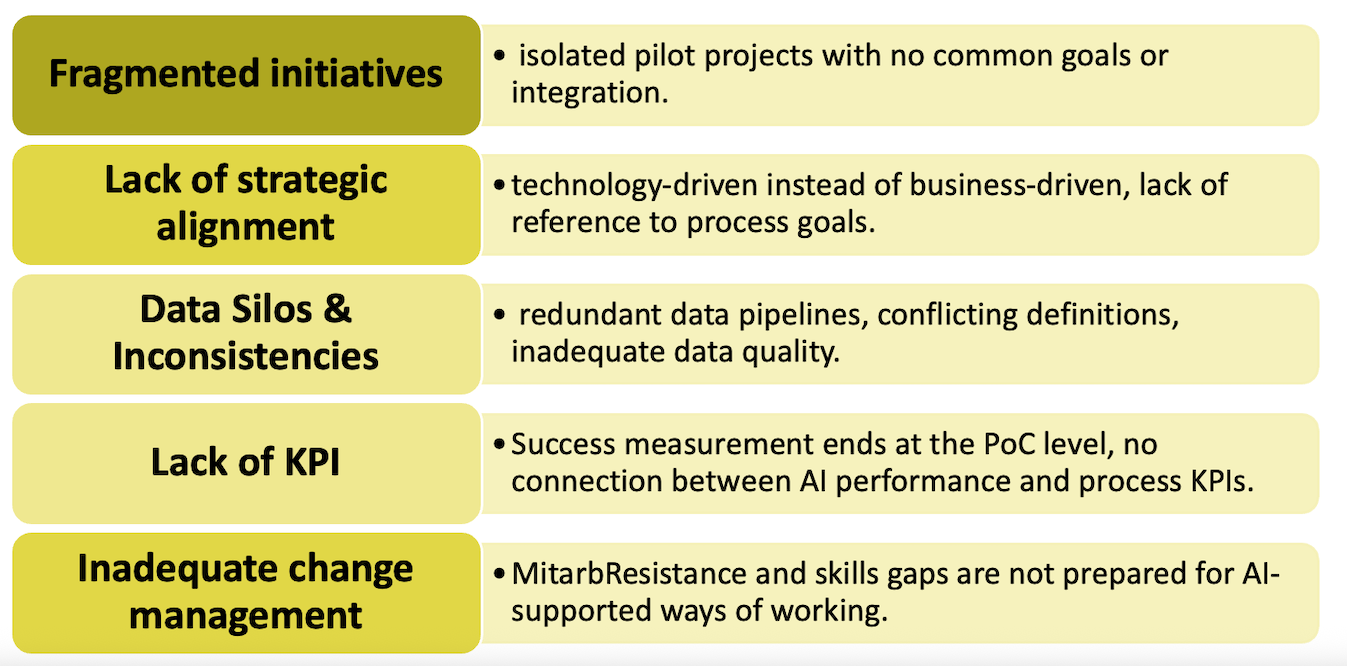
Too often, organisations start AI activities in isolation — a chatbot here, a document classifier there, an automation experiment somewhere else. The result is a collection of disconnected pilots with no strategic or operational anchor.

A process-centric approach changes that.

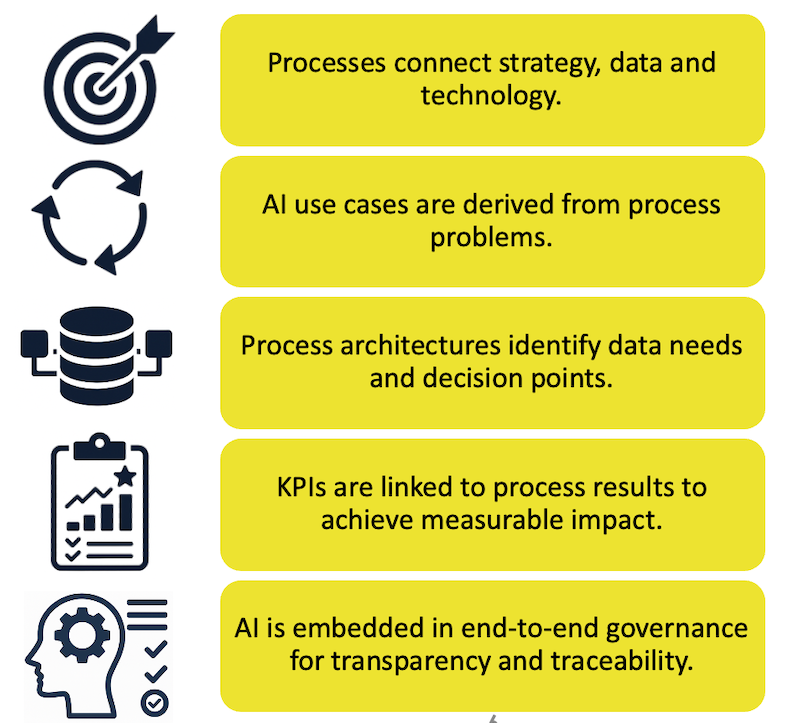
1. Strategy and operations stay connected

Processes operationalise strategy.

Embedding AI into processes ensures your AI efforts support strategic goals instead of creating technical “side projects”.

2. Clear roles and responsibilities

A process model clarifies:

  • Which roles interact with AI

  • Who owns the data

  • Where decisions are made

  • How compliance and governance are ensured

Without this clarity, AI becomes a black box nobody feels accountable for.

3. Understanding where AI actually adds value

AI makes sense where:

  • Tasks are repetitive but variable

  • Unstructured data must be analysed

  • Complex decisions require support

  • Manual handovers generate delays or errors

  • Documents need comparison, validation, extraction

But many pain points can be solved more easily:

  • with basic digitalisation,

  • with standard ERP functionality,

  • or by adjusting process logic.

A structured process assessment very quickly separates true AI use cases from tasks that only look like AI problems.

AI Use Cases Need a Clear Evaluation Framework

To avoid hype-driven decision-making, organisations should assess every use case along a consistent canvas:

✔ Data readiness

Do we have the required input (structured, unstructured, labelled, historical)?

✔ Process impact

Which steps, handovers, and decisions are affected?

✔ Financial expectations

Is there a measurable business case — cost savings, throughput, quality, risk reduction?

✔ Strategic relevance

Does the use case contribute to strategic goals or capability building?

✔ Change & Adoption

Which roles must learn new work patterns?

What training, enablement, and organisational adjustment is needed?

Addressing these questions first, avoids “cool experiments” and instead builds a portfolio of well-positioned, value-oriented, outcome-driven AI cases.

Before Starting: Assess Your AI Maturity

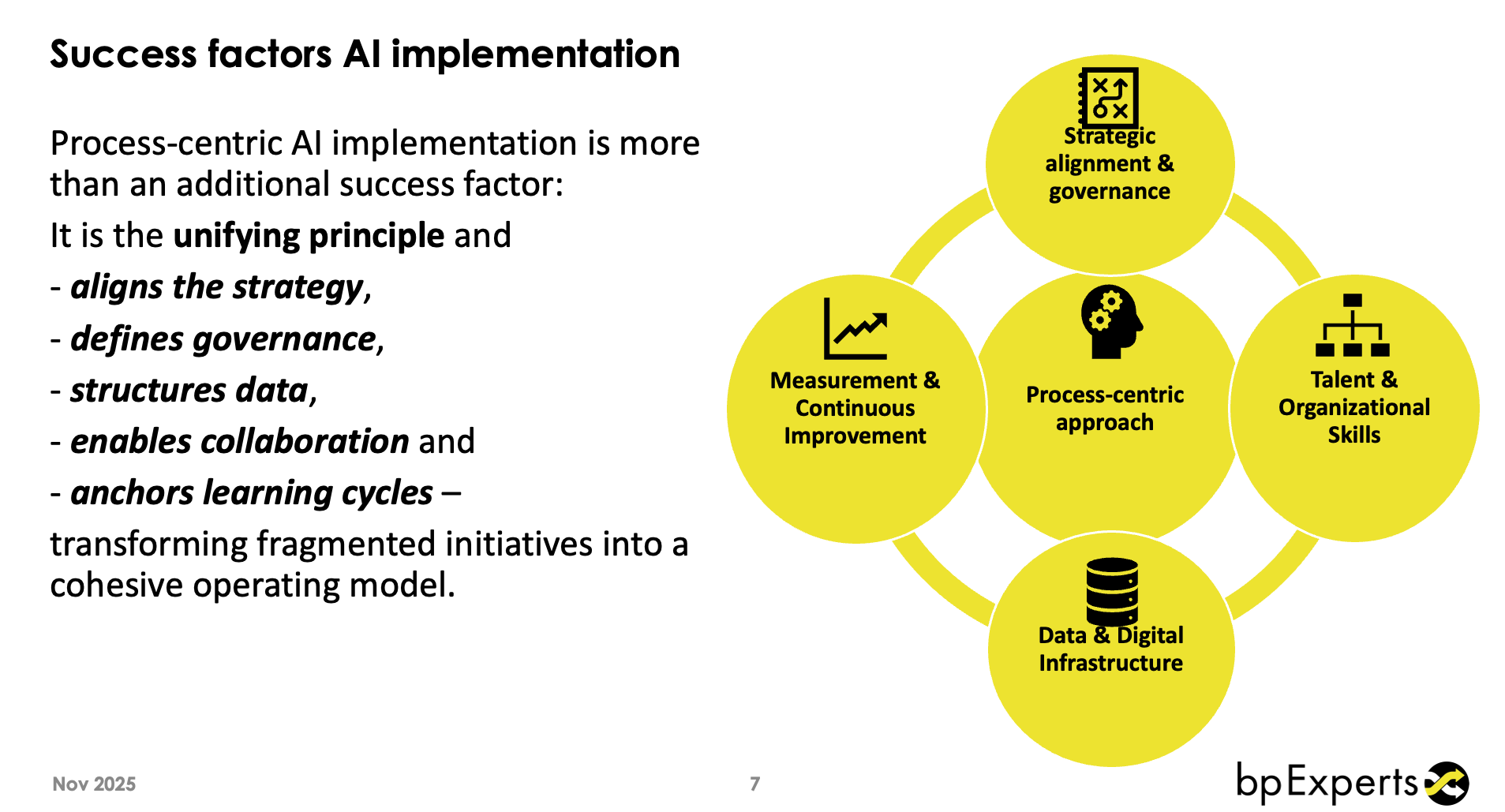
Every AI initiative should begin with a quick maturity check across five success factors:

  1. Process governance

  2. Data governance

  3. Roles & responsibilities

  4. Technology readiness

  5. Change & adoption capability

This determines whether the organisation is ready to scale AI beyond isolated pilots — or whether foundational work must come first.

The Role of New (and Evolving) Responsibilities

AI changes the organisational landscape.

Companies must answer questions such as:

  • Do we still need classical key users?

  • Should process owners evolve into “AI champions”?

  • Do we introduce dedicated AI governance roles?

  • How does compliance adapt to AI-driven decisions and data flows?

Existing governance models shouldn’t be replaced — but challenged and expanded to include AI-specific responsibilities.

From Chaos to Structure in Three Months

In many client projects, we see dozens of parallel, uncoordinated AI activities — each started with good intent but without integration.

With a structured process- and governance-driven approach, organisations can:

  • consolidate their AI activities,

  • establish a unified roadmap,

  • clarify data and process responsibilities,

  • and align all ongoing projects to a common direction.

This can be achieved in as little as three months, depending on stakeholder engagement. What follows — scaling pilots into daily operations across multiple sites and departments — naturally takes longer, but the foundation is laid.

A Practical Example: Should You Give the “Actual Process” to an AI for Improvement?

One question from the KI-Week audience was:

“If I document my current process and feed it into an AI, can the AI generate improvement suggestions?”

The answer: Yes — but start one step earlier.

If no consistent process documentation exists, begin with:

  • the key questions process managers must answer,

  • the roles involved,

  • the decision points,

  • the data that flows through the process.

Without this context, AI suggestions remain shallow. With the right context, AI can highlight improvement potential across decision logic, handovers, data usage, and automation opportunities.

Conclusion: AI Needs Process Thinking

If we summarise everything into three messages, it’s this:

1. AI requires a process mindset, not a project mindset

Technology alone doesn’t solve problems.

Embedded in processes, AI becomes a strategic accelerator.

2. Your process models are the compass for AI transformation

They provide orientation, responsibility, data structures, and governance.

3. Every use case must be evaluated in the context of the whole organisation

Only then can AI scale sustainably instead of becoming a collection of isolated experiments.

Organisations that embrace this process-centric AI approach will not just implement technology — they will build lasting capabilities for transformation.

Celebrating 50 Episodes of Insight from the BPM360 Podcast

Celebrating 50 Episodes of Insight from the BPM360 Podcast

The BPM360 Podcast by our Partner Dr. Russel Gomersall and Caspar Jans (Celonis) has become an established platform for sharing perspectives on business-process management, automation, and digital transformation.
Its purpose is straightforward: to provide clear, experience-driven insights into how processes operate across modern organizations, how technologies are reshaping them, and which trends are defining the next generation of BPM practices. Through conversations with experts and practitioners, the podcast brings forward real challenges, emerging opportunities, and the ongoing evolution of the BPM landscape.

A significant milestone has now been reached with the release of Episode 50.

Check out the milestone episode here.

What This Milestone Represents

Fifty episodes reflect more than consistency — they mark the growth of a knowledge hub that continues to support and inform the BPM community. Over time, the podcast has developed a comprehensive library of discussions covering topics such as process mining, orchestration, operational excellence, automation frameworks, and the shifting roles of technology platforms.
Reaching this point reinforces the value of sustained dialogue in a field that evolves rapidly and often unpredictably.

Inside Episode 50

The milestone episode focuses on a timely and highly relevant topic: the role of ServiceNow’s process orchestration capabilities in shaping the next chapter of BPM.
Key themes include:

  • The strategic expansion of orchestration across enterprise systems

  • The influence of recent market movements, including major acquisitions in the BPM and process mining space

  • How platforms are shifting from isolated workflows toward interconnected, intelligence-driven process landscapes

  • The growing necessity for orchestration layers that sit above traditional applications and integrate processes end to end

The episode provides a forward-looking exploration of how BPM is transitioning from improvement initiatives to an orchestration-centric model that connects processes, data, and automation frameworks across the enterprise.

Looking Ahead

With 50 episodes now available, the BPM360 Podcast continues to build momentum. Future discussions are expected to dive deeper into process intelligence, orchestration strategies, automation-driven operating models, and the evolving ecosystems surrounding modern BPM platforms. The milestone marks both a reflection point and a launchpad for even more advanced conversations about the future of process work.

Mehr als Modellierung: Wie Künstliche Intelligenz das Prozessmanagement mit ARIS neu definiert

Die Integration von Künstlicher Intelligenz (KI) in das Prozessmanagement ist kein Zukunftsthema mehr – sie ist gelebte Gegenwart. Ob Prozessdokumentation, Analyse oder Process Mining: KI verändert, wie Unternehmen zukünftig ihre Prozesse gestalten, steuern und verbessern. Insbesondere Tools wie ARIS mit integriertem AI Companion zeigen eindrucksvoll, wie KI heute schon reale Mehrwerte liefert – über alle Phasen des Prozessmanagements hinweg.

Wie kann KI im Prozessmanagement unterstützen?

Viele Unternehmen – besonders im Mittelstand – sehen sich derzeit mit einer Vielzahl an Herausforderungen konfrontiert. Ständig wachsende Compliance-Anforderungen und sich verändernde wirtschaftspolitische Rahmenbedingungen erfordern ein grundsätzlich neues Denken hinsichtlich der Marktpositionierung, eine Anpassung der Organisation sowie eine Neuausrichtung der gesamten Supply Chain. Im Kern bedeutet dies, Veränderungen proaktiv anzustoßen, Prozesse fokussiert und zügig neu aufzusetzen und diese anschließend effizient zu steuern. Vor diesem Hintergrund ist es nicht verwunderlich, dass der Ruf nach Technologien laut wird, die schnelle und messbare Erfolge ermöglichen. Entsprechend hoch sind die Erwartungen an KI-basierte Lösungen – sie sollen beispielsweise

  • Kundenerlebnisse verbessern – durch smarte Marktanalysen

  • Kosten reduzieren – durch Unterstützung fundierter Entscheidungen

  • Produktivität steigern – durch Automatisierung von Routineaufgaben

  • Risiken frühzeitig erkennen – durch KI-gestützte Auswertung von Unregelmäßigkeiten

Viele Softwarehersteller integrieren inzwischen eigene KI-Funktionen direkt in ihre Anwendungen. Darüber hinaus stehen auch externe KI-Tools wie ChatGPT, Copilot oder der ARIS AI Companion zur Verfügung – intuitiv bedienbar und schnell einsetzbar.
In der Vielfalt an verfügbaren Lösungen ist jedoch eines entscheidend: Erst das Zusammenspiel von Technologie, fachlicher Expertise und klarer Governance ermöglicht einen wirklich sinnvollen und nachhaltigen Einsatz von KI.

Von der Idee zur Umsetzung: So gelingt der Einstieg

  • Relevante Use Cases identifizieren und priorisieren

    Ermitteln Sie gezielt Anwendungsfälle, in denen KI echten Mehrwert liefern kann – etwa:

    • Kundenzentrierung durch personalisiertes Marketing,

    • Effizienzsteigerung im Service durch intelligente Chatbots,

    • Risikominimierung durch automatisierte Erkennung von Prozessabweichungen (z. B. im Compliance-Bereich).

    Wichtig ist, Use Cases auszuwählen, die sowohl geschäftlich relevant als auch technisch machbar sind und dabei erste Erfolge sichtbar machen.

  • Mit Pilotprojekten starten – „Think big, start small“
    Beginnen Sie mit klar abgegrenzten Pilotprojekten, um Erfahrungen im Umgang mit KI-Technologien, Tools wie dem ARIS AI Companion und neuen Arbeitsweisen zu sammeln.

    • Stellen Sie sicher, dass Projektmitarbeitende ausreichend Kapazität haben – KI-Piloten sollten nicht „nebenbei“ laufen.

    • Fördern Sie die interdisziplinäre Zusammenarbeit zwischen Fachbereichen, IT und Data/AI-Teams von Anfang an.

  • Datenverfügbarkeit und Governance klären
    Ohne verlässliche Daten kein wirksamer KI-Einsatz. Klären Sie daher frühzeitig:

    • Welche Daten liegen vor?

    • Wo sind diese verfügbar (z. B. im Prozessportal, ERP, CRM)?

    • Wer trägt die Verantwortung für Datenqualität und -zugang?

    • Unterstützt Ihre Prozessdokumentation bereits strukturierte, maschinenlesbare Informationen?

    Eine klare Governance ist essenziell – auch um Risiken beim KI-Einsatz (Bias, Blackbox-Verhalten) frühzeitig zu adressieren.

  • Erkenntnisse skalieren & automatisieren
    Nutzen Sie Erkenntnisse aus Pilotprojekten, um ähnliche Prozesse im Unternehmen zu optimieren.

    • Setzen Sie gezielt KI-Agents ein, um repetitive Tätigkeiten zu automatisieren.

    • Integrieren Sie KI in den gesamten Prozesslebenszyklus – von Modellierung über Simulation bis zur kontinuierlichen Verbesserung.

  • Prompt-Kompetenz & Toolnutzung fördern
    Schulen Sie Mitarbeitende gezielt im Umgang mit KI-Tools und Prompt-Engineering:

    • Wie formuliere ich effektive Prompts für Prozessmodellierung oder Analyse mit dem ARIS AI Companion?

    • Wie lässt sich die eigene Toolkompetenz kontinuierlich verbessern?

    Nur durch gezielte Qualifizierung kann KI ihre Wirkung im Arbeitsalltag entfalten – und wird zum echten Assistenzsystem für Prozessverantwortliche.


ARIS & KI – mehr als nur Modellierung

Im Bereich des Prozessmanagements setzt ARIS mit seinen KI-gestützten Funktionen neue Maßstäbe. Durch die Integration des AI Companion wird es möglich, per natürlicher Sprache Prozesse zu modellieren, automatisiert zu analysieren und Optimierungspotenziale aufzudecken – direkt innerhalb der zentralen Prozessmanagementplattform. Damit unterstützt ARIS nicht nur die Effizienzsteigerung in der Prozessdokumentation, sondern fördert auch datenbasierte Entscheidungen und eine neue Qualität der Zusammenarbeit zwischen Fachbereichen und IT. Die KI wird so zum aktiven Sparringspartner im gesamten Lebenszyklus des Prozessmanagements – von der Ideengenerierung bis hin zur kontinuierlichen Verbesserung.

🧠 Beispielhafte KI-Funktionen in ARIS:

Prompt-Tipps aus der Praxis

„Generiere ein Modell für den Warenausgang mit folgenden Schritten: Auftrag prüfen → Ware kommissionieren → Lieferschein erstellen → Versand.“

→ ARIS Companion erstellt ein BPMN-Modell mit Aufgaben, Rollen und Systemen. 

„Zeige mir alle Prozesse mit Durchlaufzeiten über 7 Tage.“

→ Process-Mining-Auswertung mit KI-gestützter Priorisierung von Bottlenecks.

„Welche KPIs sind für den Genehmigungsprozess definiert?“

→ Automatische Auslesung und Verlinkung zu KPI-Glossareinträgen.

Beispiel Prompt: Suche nach speziellen Informationen in der ARIS Datenbank mit natürlicher Sprache

KI Mehrwert im Process Mining – der versteckte Gamechanger

Künstliche Intelligenz liefert nicht nur bei der Prozessmodellierung einen Mehrwert – auch im Process Mining entfaltet sie enormes Potenzial, um Prozesse effizienter, robuster und transparenter zu gestalten:

  • Automatische Identifikation von Prozessvarianten

    Erkennen Sie auf Knopfdruck, welche Varianten vom definierten Soll-Prozess abweichen – inklusive Häufigkeit und Auswirkungen.

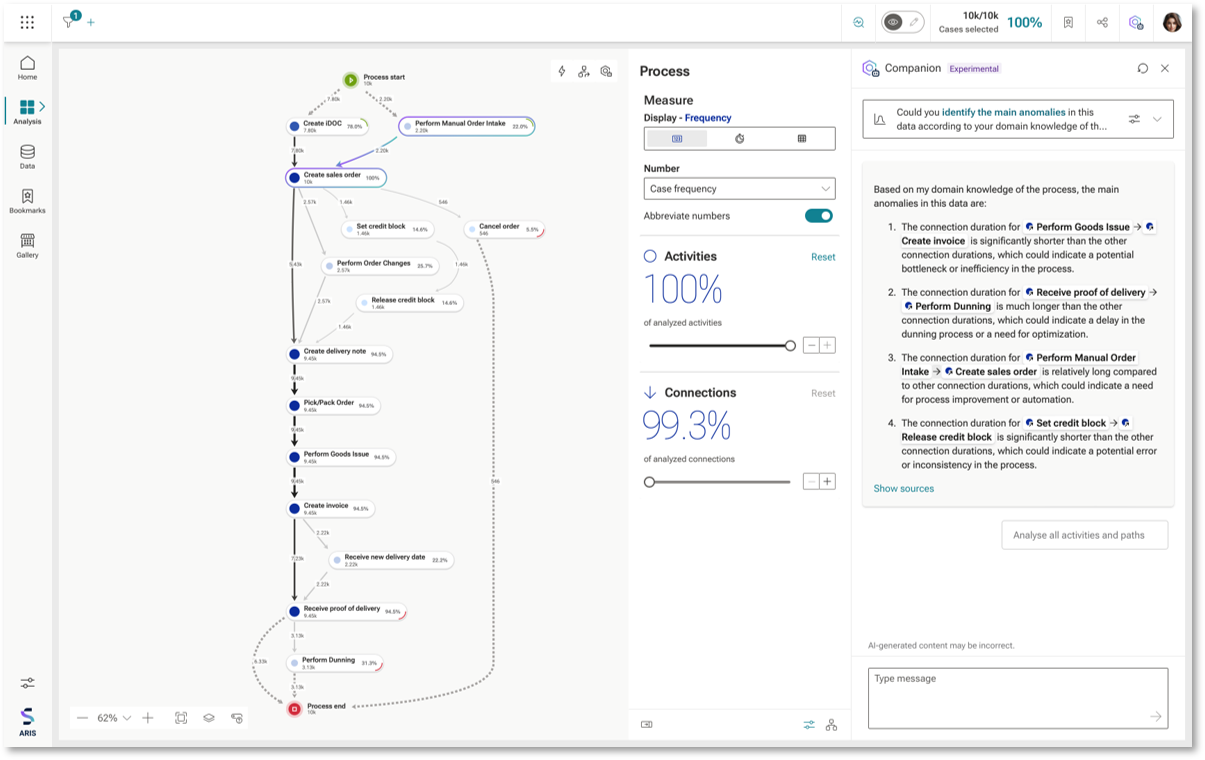
  • Anomalie-Erkennung in Echtzeit

    Beispielsweise bei fehlenden Freigaben, Umgehungen oder Compliance-Verstößen – bevor diese zu echten Problemen werden. ARIS Process Mining kann hier gemeinsam mit ARIS Compliance Manager ein direkter Weg zur Umsetzung von Compliance Richtlinien sein, da erkannte Anomalien umgehend als issues angelegt und zur Prüfung angetriggert werden.

  • Optimierungsvorschläge auf Basis historischer Daten

    KI erkennt Muster, bewertet Potenziale und schlägt gezielt Verbesserungsmaßnahmen vor – datengestützt und objektiv.

  • KI-gestütztes Clustering von End-to-End-Prozesspfaden

    Komplexe Abläufe werden strukturiert visualisiert und in verständliche Gruppen überführt – ideal zur Ursachenanalyse und Kommunikation mit Fachbereichen.

Beispiel: Erkennung von Anomalien im IST Prozess

Fazit: KI als Transformationsmotor im Prozessmanagement

Künstliche Intelligenz ersetzt kein Fachwissen – sie verstärkt und ergänzt es. Besonders im Zusammenspiel mit leistungsfähigen Plattformen wie ARIS entfaltet KI ihre volle Wirkung entlang des gesamten Prozessmanagement-Zyklus:

  • Von der strukturierten Datenerhebung,

  • über intelligente Analyse und automatisierte Modellierung,

  • bis hin zur kontinuierlichen Verbesserung und Steuerung komplexer Prozesslandschaften.

 Erfolgsfaktoren:

  • Fokus auf relevante Prozesse mit klarem Geschäftsnutzen

  • Definierte Rollen & Governance-Strukturen für sichere Anwendung

  • Schulung & Change-Kommunikation, um Akzeptanz zu schaffen

  • Vertrauen in datengetriebene Entscheidungen, auch bei Unsicherheit

 Ausblick

Die Zukunft des Prozessmanagements ist geprägt von der Kombination aus:

  • Agentic AI – autonome KI-Systeme, die Prozesse nicht nur analysieren, sondern proaktiv steuern.

  • Process Intelligence – tiefere Einsichten durch nahtlose Integration von Daten, Prozessen und Kontextwissen.

  • Business Empowerment – Fachbereiche werden zu aktiven Mitgestaltern datengetriebener Prozesse.

Doch bei aller technologischen Dynamik gilt auch:

Stabilität:

  • Prozesse brauchen Struktur und Klarheit – auch KI basiert auf gut dokumentierten Abläufen.

  • Fachliche Expertise bleibt unverzichtbar – KI ist ein Verstärker, kein Ersatz.

  • Governance, Verantwortlichkeiten und Transparenz behalten zentrale Bedeutung.

Veränderung:

  • Modellierung, Analyse und Optimierung werden interaktiv und KI-gestützt.

  • Fachbereiche agieren datengetriebener und autonomer – ohne auf die IT zu warten.

  • Prozesse sind nicht mehr statisch, sondern lernen und passen sich kontinuierlich an.

ARIS mit dem AI Companion steht an der Schnittstelle dieser Transformation. Die Plattform bleibt vertraut in Struktur und Governance – wird aber durch KI zu einem intelligenten Co-Piloten im täglichen Prozessmanagement. Die Zukunft beginnt jetzt – und sie bringt mehr Chancen als Risiken.